Ecommerce UX Agency: How to Choose and Hire the Right One
- ecommerce ux agency
- shopify ux
- cro agency
- ux design
Launched
September, 2026
You've fixed the obvious problems. The storefront loads quickly, the product photography is strong, and paid traffic keeps arriving. Yet the conversion rate remains stubbornly low. Customers browse, add products to their baskets, then disappear when delivery details, payment choices, account requirements, or returns information become difficult to understand.
That situation is rarely solved by another visual refresh. A capable ecommerce UX agency examines the complete customer journey, including navigation, product discovery, checkout, delivery communication, account management, returns, and the information architecture connecting them. In the UK, that broader view matters because online spending accounted for 50.5% of total UK card spending in September 2025, compared with 43.7% in September 2019, according to UK ecommerce market data.
What an Ecommerce UX Agency Actually Does
A founder often contacts an agency after seeing the same pattern in analytics. Product pages attract visits, campaign landing pages perform reasonably well, and mobile traffic is healthy. The problem appears later. Shoppers hesitate over delivery timing, struggle to compare variants, fail to find returns information, or reach checkout without enough confidence to complete the purchase.
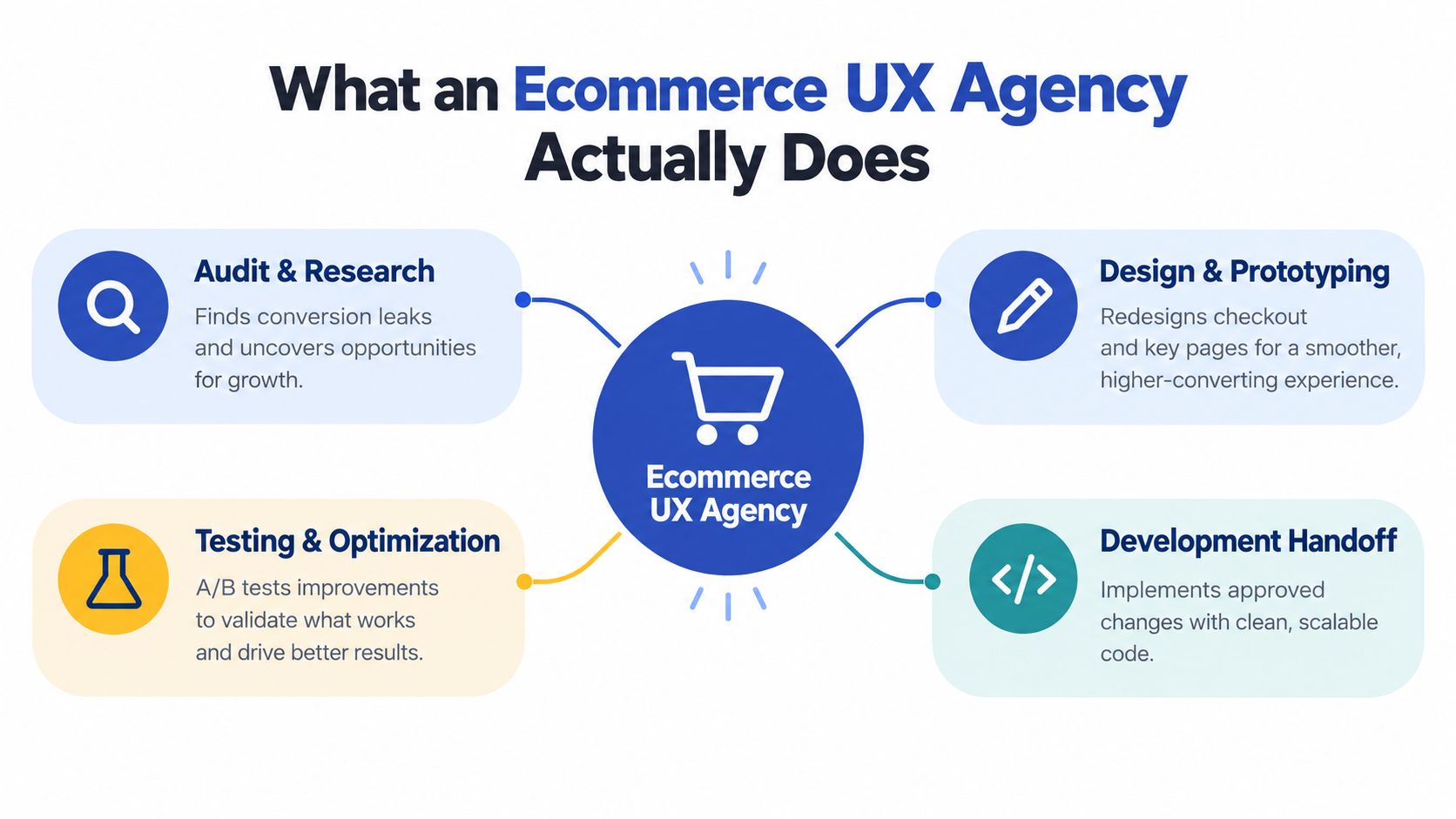
An ecommerce UX agency investigates those moments rather than treating the homepage as the main problem. Its work combines user research, interface design, information architecture, usability testing, conversion rate optimisation, and technical implementation. The aim isn't to make a store look fashionable. It's to make important decisions easier for real customers.
The difference between decoration and diagnosis
A visual redesign might change typography, colour, spacing, and imagery. Those changes can help, but they don't answer fundamental questions:
- Can shoppers understand which product suits their needs?
- Are delivery fees visible before customers invest time in the basket?
- Does the mobile layout support comparison, filtering, and quantity changes?
- Can customers buy without creating an account?
- Do returns, payment, and fulfilment messages appear where uncertainty arises?
An experienced team starts with evidence. It reviews analytics, recordings, search behaviour, support tickets, customer interviews, usability sessions, and the actual behaviour of the storefront. It then maps friction to commercial outcomes and prioritises changes according to effort, risk, and likely impact.
Practical rule: If an agency proposes a new homepage before asking how customers choose products, receive orders, and request returns, it probably hasn't understood the business yet.
Information architecture deserves particular attention. A customer may abandon before checkout because the site hides delivery thresholds, buries product comparisons, or separates important policy information from the decision it supports. Guidance on how to optimise your online store UX is useful as a starting point, but a specialist must apply those principles to your catalogue, fulfilment model, customer expectations, and platform constraints.
The work can include journey mapping, wireframes, design systems, Shopify theme development, app integration, experimentation, and post-launch measurement. You can see how these disciplines connect in Grumspot's ecommerce UI and UX design work, particularly where interface decisions need to survive real development and operational constraints.
Core Services Explained
The phrase “UX agency” covers several different services. Confusing them creates poor briefs and disappointing outcomes. UX design determines how customers understand and move through the store. CRO tests whether proposed changes improve behaviour. An audit identifies problems and prioritises them. Platform migration and development make the resulting experience possible in production.
The UK context raises the stakes. The IRP Commerce market dataset reported an all-sector average conversion rate of 2.26% in July 2026, with fashion at 1.81%, food and drink at 1.47%, and baby and child at 0.55%. The same dataset recorded 5.23% for arts and crafts and 3.57% for health and wellbeing. Those differences show why an agency should benchmark your store against its category rather than quote a broad ecommerce average.
UX design and information architecture
UX design covers the structure and presentation of the shopping journey. It includes navigation, search, category pages, filters, product detail pages, basket behaviour, checkout, account areas, delivery messaging, and returns flows.
The strongest work begins with customer tasks. A specialist might prototype how a shopper chooses a gift, compares technical specifications, selects a subscription, or checks whether an item arrives before a particular event. The design then makes those tasks visible and predictable.
Information architecture is often more valuable than a new visual style. Clear category labels, useful filters, contextual delivery information, and well-placed policy links reduce the mental effort required to buy. A store can retain its existing brand identity while becoming substantially easier to use.
Audits as a prioritisation tool
An audit should produce more than a long list of interface complaints. It should connect each finding to a customer problem, affected journey, evidence source, recommendation, implementation effort, and measurement plan.
A useful audit may combine heuristic review, analytics analysis, mobile testing, accessibility checks, technical performance review, search examination, and moderated usability research. It should also identify what not to change. Removing a familiar feature without understanding its role can create new friction.
CRO and experimentation
CRO turns design assumptions into testable decisions. The team forms a hypothesis, defines the primary and guardrail metrics, selects an audience, runs the test responsibly, and records the decision regardless of the outcome.
Not every change deserves an A/B test. A broken delivery selector, inaccessible form, or confusing error message may need direct correction. Testing is most useful when the business has meaningful uncertainty between plausible alternatives, such as how to present delivery choices or which product information should appear first.
For businesses seeking a longer-term strategic UX design partner, the important question is whether the agency can connect research, design, experimentation, and engineering. A polished prototype that never reaches production has no commercial value.
Migration and technical delivery
A migration from Magento, WooCommerce, or a custom platform is not just a theme transfer. It can affect product data, URLs, customer accounts, subscriptions, stock, fulfilment, tax logic, search, analytics, and third-party integrations.
Ask the agency how it will protect existing customer journeys during the change. The plan should include requirements discovery, content and data mapping, integration testing, redirect planning, staged quality assurance, and post-launch monitoring. The best-looking design still fails if customers can't find products, receive accurate delivery information, or complete payment.
Hiring the Right Partner
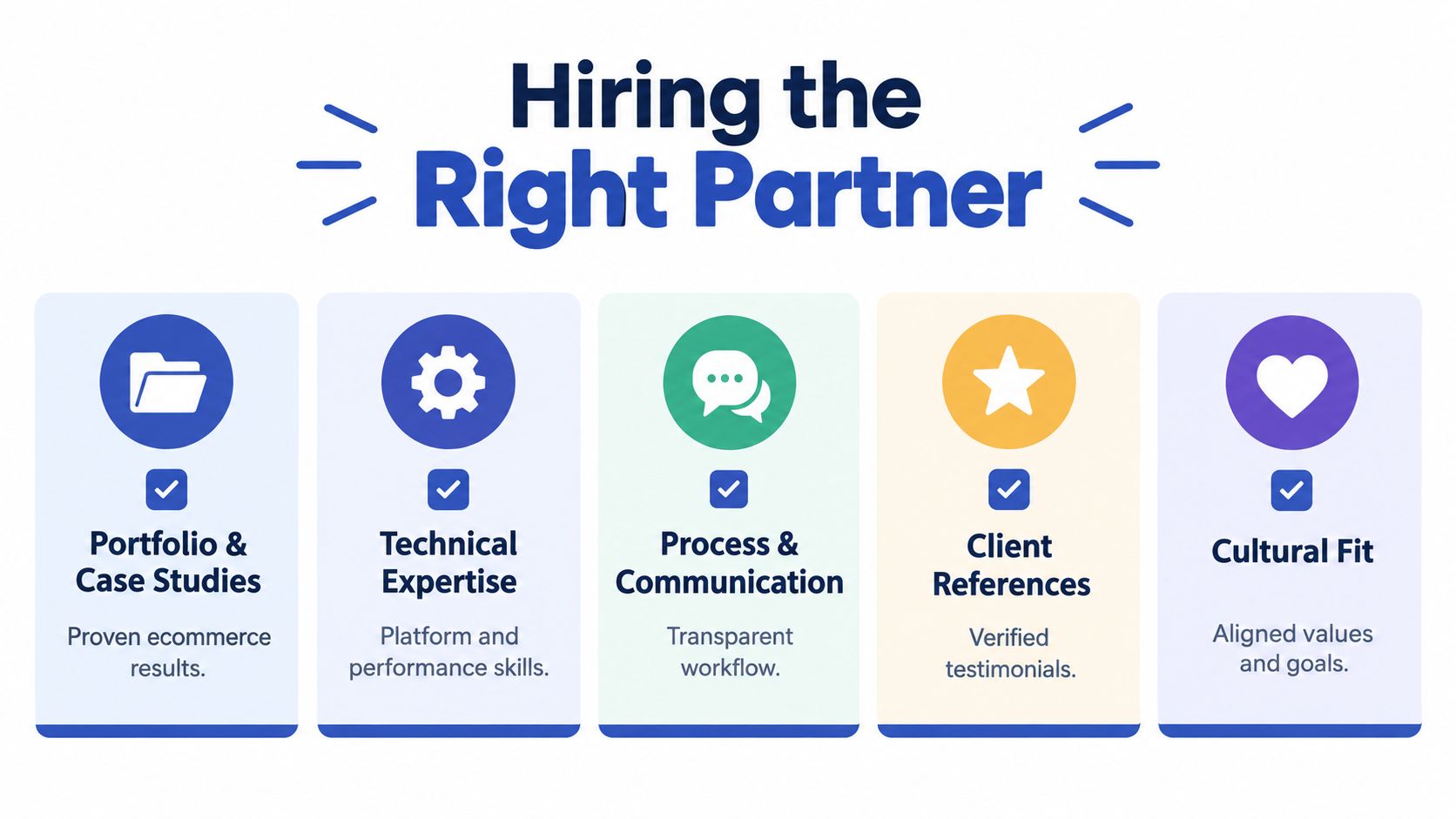
Choose an ecommerce UX agency by examining how it thinks, not by judging the polish of its own website. An agency can produce beautiful mock-ups and still lack experience with catalogue complexity, subscription logic, international markets, ERP connections, or the operational realities of a growing retailer.
Start with the type of problem you need solved. If product discovery is weak, ask for research and information architecture examples. If checkout abandonment is the concern, request evidence of usability testing, delivery-flow work, payment integration experience, and post-launch measurement. If you're migrating platforms, ask for a technical delivery plan rather than a collection of screenshots.
Questions that reveal competence
Use the first call to test the agency's method:
- Research approach: Which customer behaviours, analytics reports, support conversations, and usability tasks will you review before recommending changes?
- CRO method: How do you form hypotheses, choose test metrics, and decide what to do when a test is inconclusive?
- Technical ownership: Who handles Shopify theme development, app conflicts, integrations, accessibility, performance, and quality assurance?
- Migration control: How will you map content, preserve important URLs, test fulfilment workflows, and limit disruption during launch?
- Commercial measurement: Which customer and business outcomes will you track after release, and how will you separate UX impact from changes in traffic or merchandising?
You should also ask to speak with relevant former clients. Request examples from a similar retail category, platform, business model, or operational setup. A portfolio full of brochure sites doesn't prove an agency can improve a complex ecommerce journey.
Look for honest trade-offs
Good partners explain what they wouldn't change yet. They distinguish a high-risk checkout alteration from a low-risk content improvement, and they tell you when a development constraint makes a particular solution expensive or fragile.
Communication matters just as much. Establish who owns decisions, how feedback is recorded, how often progress is reported, and what happens when the agency discovers a problem outside the original brief. An agency that communicates clearly before the contract is more likely to manage uncertainty well after work begins.
The embedded video offers another useful perspective on the kinds of considerations involved when assessing an ecommerce UX partner.
Engagement Models and Pricing
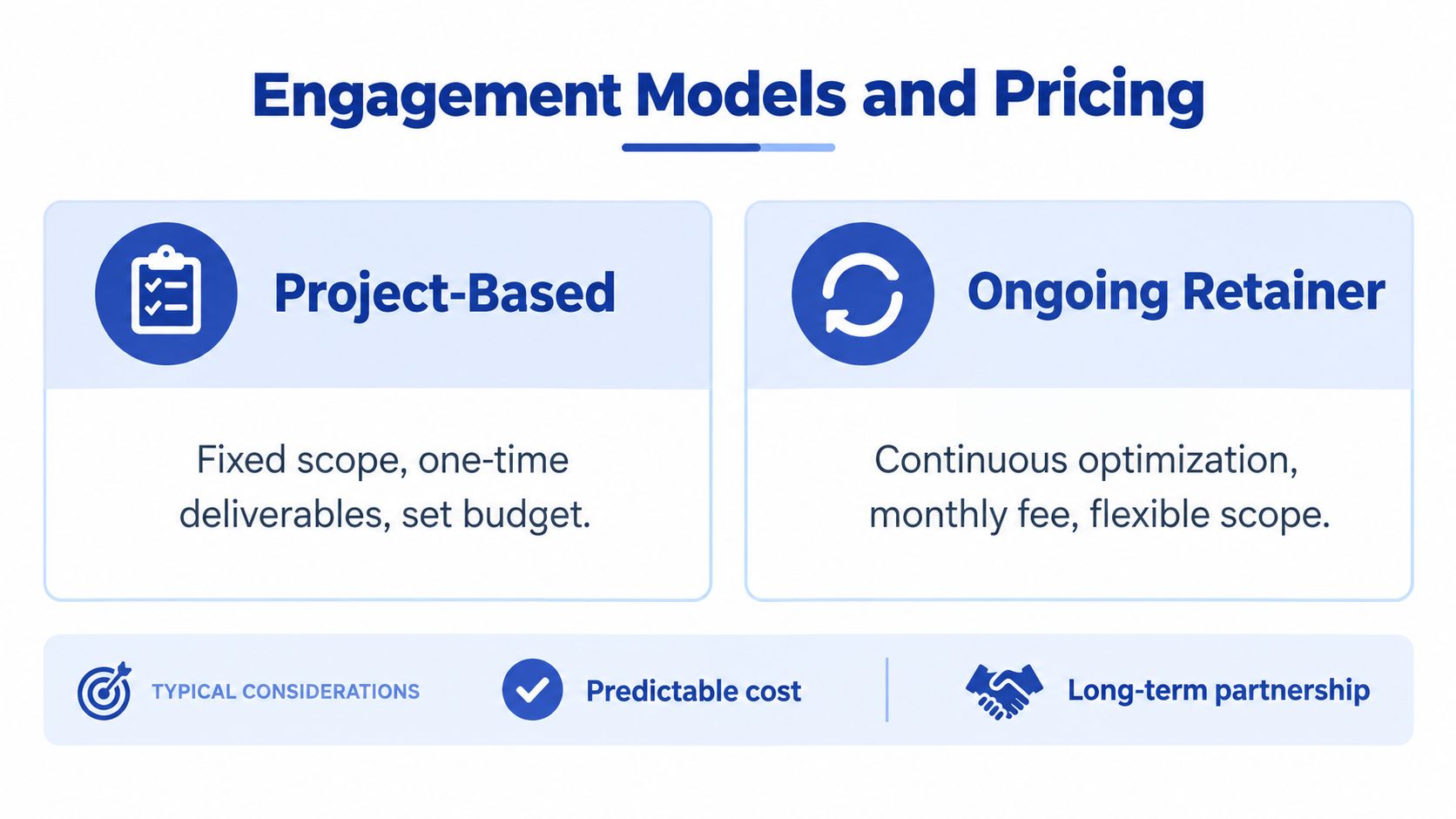
The right commercial model depends on the shape of the problem. A defined migration has a different management requirement from an ongoing stream of research, testing, design, and development. Treating every engagement as a monthly retainer can make a clear project feel vague. Treating every problem as a fixed project can leave a store unsupported once the initial changes launch.
Project-based work
A project suits a defined outcome, such as a Shopify 2.0 rebuild, platform migration, navigation restructure, or checkout redesign. You can agree scope, milestones, responsibilities, acceptance criteria, and a budget before delivery begins.
The trade-off is flexibility. If research uncovers a larger issue in product discovery or fulfilment communication, the agency may need to raise a change request. A tightly fixed scope protects cost control, but it can discourage useful discoveries unless the contract allows sensible prioritisation.
Ongoing retainers
A retainer works when the store needs continuous improvement and access to several disciplines. The agency can maintain a research backlog, review performance, design improvements, run experiments, support releases, and handle emerging technical needs.
Retainers require active governance. Without a clear backlog and decision process, the relationship can become a queue of small requests rather than a coherent optimisation programme. Define the team involved, available capacity, meeting rhythm, reporting format, and criteria for prioritising work.
A practical comparison looks like this:
| Model | Best suited to | Main advantage | Main risk |
|---|---|---|---|
| Project-based | Migration, rebuild, or defined redesign | Clear scope and delivery point | Less support after launch |
| Ongoing retainer | Continuous CRO, UX, and development | Consistent access to expertise | Scope can become unclear |
| In-house team | Brands with sustained internal demand | Deep product and operational knowledge | Hiring and management overhead |
An in-house team offers control and context, but it may not cover every specialist skill. An agency can add research, UX, CRO, Shopify development, or integration expertise without requiring permanent hires. Some retailers use a hybrid model, with internal ownership of priorities and an external partner handling complex delivery.
If experimentation is central to the brief, review the practical considerations in Shopify A/B testing services. The contract should state how tests are implemented, who owns the code, how results are documented, and whether winning variations become part of the production experience.
Proven Results and ROI
UX investment only becomes credible when you connect it to a measurable commercial problem. A prettier product page isn't a business case. A clearer delivery promise, a more useful product comparison, a simpler account flow, or a better returns journey can be one, provided the team defines the expected customer behaviour and measures what changes.
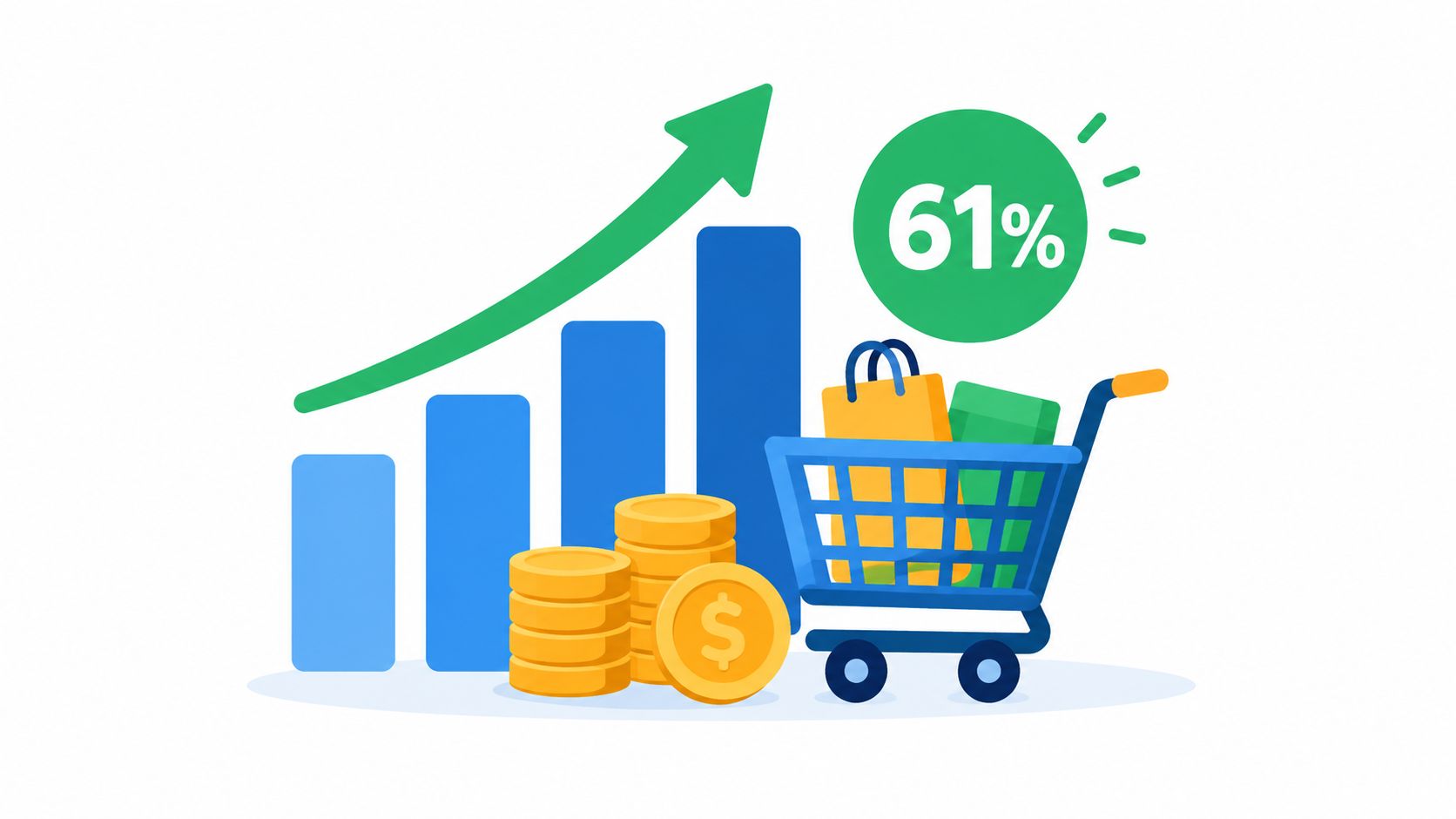
Retail Economics found that 24.8% of attempted online purchases are abandoned because shoppers can't get their preferred delivery option at checkout, with estimated losses of £605 million in weekly sales and £31.5 billion annually from delivery-related abandonment, as reported in its UK basket abandonment research. The figures point to a specific opportunity. Delivery choice, cost, timing, and reassurance belong in the UX brief, not just in fulfilment operations.
Measure the chain, not one button
A solid measurement plan follows the journey:
- Discovery: Can users find the relevant category, product, or solution?
- Evaluation: Do they understand suitability, price, availability, delivery, and returns?
- Basket: Do they see the full cost and available fulfilment choices early enough?
- Checkout: Can they complete payment without avoidable confusion?
- Post-purchase: Can they track, amend, return, or receive support without unnecessary effort?
This prevents teams from celebrating a local improvement that damages another part of the experience. A new express-payment button might reduce form effort while creating account confusion. A promotion might lift basket additions while increasing support requests. Measure the full system.
The Leeds Beckett Retail Institute checkout abandonment study reports that 74% of UK baskets created in the last quarter of 2024 didn't convert into completed orders. It recommends simplifying checkout, removing hidden costs, and using user testing to find friction. That supports a disciplined approach, but it doesn't justify assuming that every store needs the same redesign.
Revenue comes from removing the obstacle that matters to your customers, not from accumulating more interface changes.
Include post-purchase value in the business case
Post-purchase UX affects trust, support demand, repeat purchase potential, and the willingness to recommend a retailer. Clear order confirmation, delivery tracking, returns instructions, account access, and proactive exception messaging can reduce uncertainty after payment.
Many briefs are too narrow. The Signifyd UK State of Commerce report states that 43% of shoppers across the UK, Germany, and the Netherlands wouldn't return after a poor checkout experience, while 44% of UK shoppers cited a cumbersome checkout as a reason for abandoning baskets. It also reports that only 34% of UK shoppers regularly store payment credentials. Those findings suggest that trust and convenience need to be designed together, rather than assuming every shopper wants the same “frictionless” path.
For a broader commercial perspective, the guide on how to optimise user experience as revenue is a useful prompt to connect usability work with financial outcomes. For deeper examples of how UX and experimentation can be evaluated, review conversion rate optimisation case studies, then ask any prospective agency to show how its own results were measured.
Next Steps for Your Store
Start with a constrained problem, not an instruction to “improve UX”. Gather your analytics, customer service conversations, search data, returns questions, delivery complaints, and recordings of real journeys. Look for repeated uncertainty. Customers often tell you where the experience fails through the questions they ask before and after ordering.
Then turn the evidence into a brief with a clear commercial context. Specify the platform, catalogue structure, fulfilment model, payment methods, international requirements, major integrations, and known operational constraints. Include post-purchase flows from the beginning, especially order tracking, delivery exceptions, returns, exchanges, and customer account access.
A practical selection process
Use a staged approach:
- Define the problem: Describe the customer task that fails and the business consequence.
- Request relevant evidence: Ask agencies for comparable UX, CRO, migration, or integration work.
- Run a diagnostic phase: Commission research or an audit before committing to a large rebuild.
- Agree priorities: Rank improvements by customer value, commercial relevance, effort, and delivery risk.
- Build and validate: Prototype important changes, test them with users, and involve developers early.
- Measure after launch: Track the journey beyond the purchase button, including delivery and returns interactions.
A diagnostic phase can feel slower than commissioning a full redesign, but it protects you from spending heavily on the wrong problem. It also gives both sides a chance to test communication, technical depth, and decision-making before the relationship becomes complex.
The UK evidence makes the priority clear. Conversion rates vary sharply by category, abandonment remains high, and delivery friction can remove demand even when the product and marketing are strong. A store's information architecture, checkout, fulfilment messaging, payment options, and post-purchase support form one connected experience.
Choose a partner that can work across those boundaries. The right ecommerce UX agency won't only present attractive screens. It will explain which customer problem each change addresses, how the change will be built, what trade-off it introduces, and how you'll know whether it worked.
Grumspot helps Shopify and Shopify Plus brands audit, redesign, migrate, and scale ecommerce experiences, including UX/UI, CRO, performance, complex integrations, and post-purchase journeys. Visit Grumspot to discuss the specific friction points in your store and decide whether a focused project or ongoing partnership is the right next step.
Let's build something together
If you like what you saw, let's jump on a quick call and discuss your project
Related posts
Check out some similar posts.

- web design agency leicester
Find the best web design agency leicester for your ecommerce brand. Our 2026 guide covers Shopify ex...
Read more
- conversion rate optimization agency
Unlock growth with a trusted conversion rate optimization agency. Learn how data-driven testing and ...
Read more