Shopify Subscription Box Guide to Launch and Scale
- shopify subscription box
- shopify subscriptions
- subscription ecommerce
- shopify plus
- DTC retention
Launched
September, 2026
A merchant usually reaches the Shopify subscription box decision after seeing the same pattern repeat. One-off orders arrive, acquisition costs rise, and the team starts asking whether customers would prefer a reliable delivery over another visit to the storefront. A recurring box appears to solve the revenue problem, but the first few renewals reveal the harder question: why should a subscriber stay when the box no longer feels convenient, relevant or easy to control?
The UK opportunity is substantial. The subscription box market reached about £1.4 billion in 2020, while Royal Mail reported nearly 88 million subscription-box deliveries to UK subscribers that year. The same report projected the market to reach £1.8 billion by 2025, showing why recurring ecommerce remains attractive to British merchants (IPC market coverage).
A successful Shopify subscription box isn't a product with a recurring payment attached. It combines a compelling offer, transparent billing, dependable fulfilment and a customer account that lets subscribers pause, skip, swap or cancel without contacting support. This guide covers the commercial decisions before configuration, app selection, Shopify setup, post-purchase operations and the retention work that keeps the model healthy.
Introduction to Shopify Subscription Boxes That Retain
A skincare merchant with reliable repeat demand faces a practical choice. Continue selling individual products and rely on customers to remember each reorder, or build a Shopify subscription box that combines replenishment with discovery. The box can improve demand planning and deepen the customer relationship, but it creates an ongoing promise. Each delivery must provide enough value, relevance and convenience to justify the next charge.
Subscription shopping now reaches beyond a specialist audience. A representative UK sample found that 38% of the population had used a subscription box service, while average subscriber tenure rose from 5.6 months to 9 months, according to Whistl consumer research. Familiarity helps acquisition, but it does not secure the next renewal. Repeated unwanted products, late deliveries or difficult account changes still drive churn.
Shopify provides the commercial foundation for recurring products. Selling plans set delivery intervals, subscription apps manage contracts and customer actions, and Shopify checkout keeps payment within a familiar buying flow. These tools support the model, but they cannot make a weak offer feel valuable or compensate for poor fulfilment.
Practical rule: Treat flexibility as part of the product, not as a support feature added after launch.
Subscribers need self-serve control over upcoming charges and deliveries. Let them pause, skip, swap or cancel without contacting support, then make those actions easy to find in the customer account. A subscriber who can adjust a box during a holiday, budget change or product surplus has a reason to stay. A rigid flow may capture one more renewal while creating a preventable support issue and a vocal detractor.
Competition is also increasing. Shopify reported a 33% increase in stores offering subscriptions in the first half of 2025 compared with the first half of 2024 in its subscription model analysis. Differentiation therefore sits in the experience around the box: relevant contents, clear communication, flexible controls, dependable packaging and a recovery path for failed payments.
Build the launch in a commercial sequence. Define the offer and economics first, choose an app that supports the required controls, configure products and checkout clearly, connect inventory and fulfilment, then test conversion and retention as one system.
Designing a Subscription Box Offer Customers Keep
A customer opens the first box, enjoys the products, then reaches a holiday period with two unopened deliveries at home. Whether that subscriber stays often depends less on the first impression than on how easily the offer adapts afterwards.
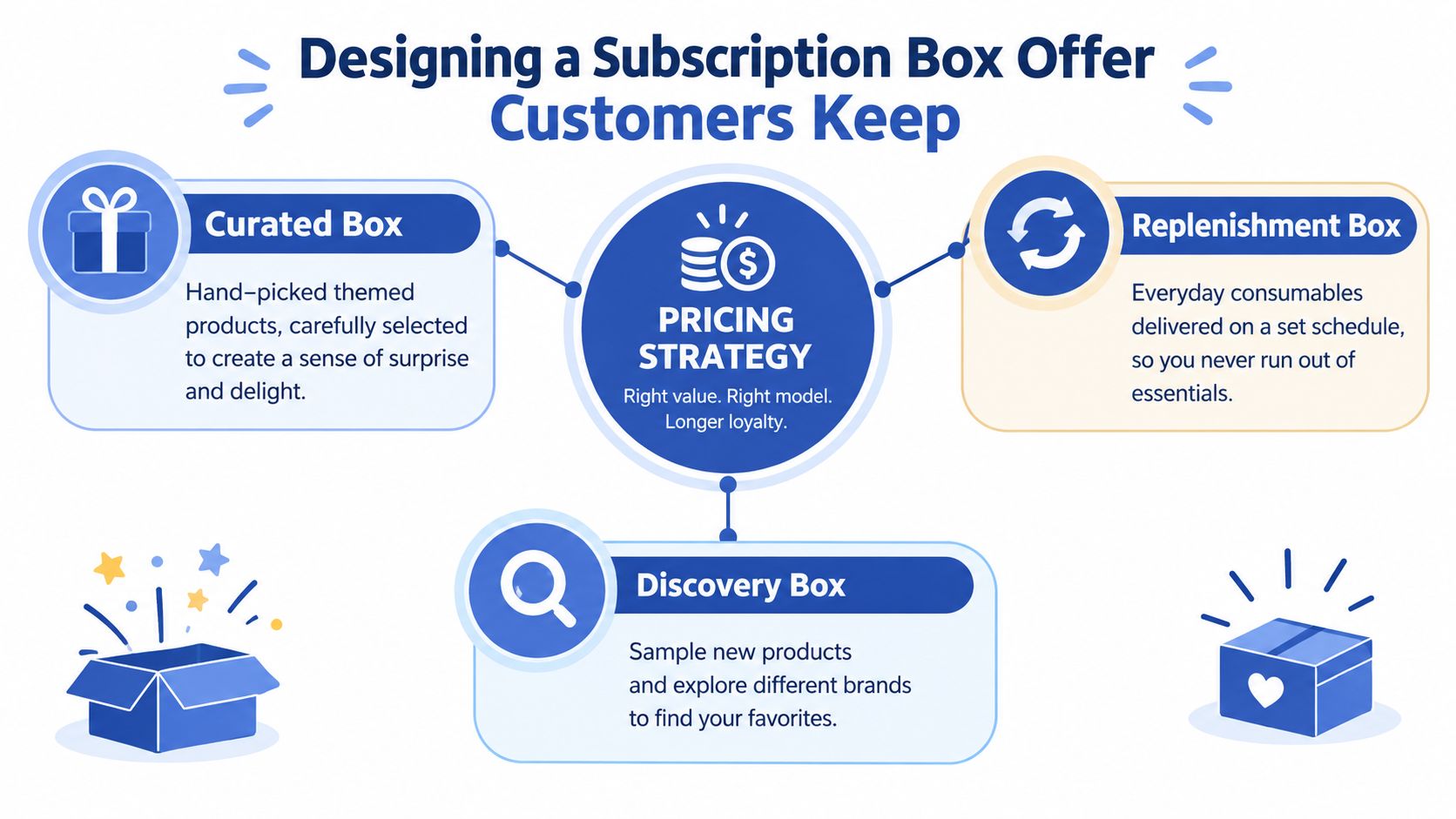
Start with the customer job. A curated box provides a themed selection chosen by the brand. A replenishment box automates repeat purchases of products the customer already uses. A discovery box makes sampling the main reason to subscribe. Each model creates a different retention obligation, so choose the format before building the product or fulfilment process.
Match the model to repeatable value
Replenishment suits predictable usage, where customers value avoiding the next purchase. Coffee, pet essentials and personal care can work well, provided the cadence reflects actual consumption. Ship too early and customers accumulate surplus. Ship too late and the convenience disappears.
Curated and discovery boxes need stronger editorial direction. Customers are buying selection, novelty and confidence that the contents will feel considered. A theme, tasting guide, usage instructions or member-only item can make the box feel designed rather than assembled.
Define the offer through a small set of decisions:
- Box promise: State the specific outcome, such as convenient replenishment, seasonal discovery or a guided routine.
- Content logic: Decide what remains consistent and what changes. Predictability helps planning, while rotation keeps the experience fresh.
- Personalisation: Offer useful choices, including preferences, sensitivities or product swaps. Limit combinations to what the warehouse can assemble accurately.
- Cadence: Let customers select a realistic delivery rhythm where the category supports it. The most frequent option is not automatically the most profitable.
- Flexibility: Mention pause, skip and swap controls before checkout. Make the ability to change the next box part of the offer itself.
Price for margin and perceived value
Calculate the full cost of every cycle, including product, packaging, pick and pack, payment processing, delivery, customer service and expected fulfilment waste. Then identify why the subscription earns its price: convenience, exclusive contents, a saving, or a combination.
A discount should support the proposition, not carry it alone. A low opening price can attract shoppers who leave once the novelty or saving fades. A stronger offer might combine a modest recurring incentive with exclusive products, early access, personalisation or useful educational content.
Prepaid plans can support cash flow and commitment, but they need clear terms and a straightforward support process. Pay-as-you-go reduces the entry barrier. Prepaid terms may suit giftable or highly seasonal offers. Test the concept with a landing page, waitlist, sample box or small pilot before funding complex build-your-own functionality.
Retention is designed between deliveries. Let customers pause during travel, skip a surplus shipment, swap an unsuitable product or change their cadence without contacting support. Those controls reduce avoidable cancellations and reveal whether the box creates value beyond its first few deliveries. A clear self-serve path also gives the operation time to solve genuine issues instead of processing routine changes manually.
Choosing the Right Subscription App for Shopify
The app decision should follow the box model, not the other way around. A simple replenishment plan may need reliable recurring billing, clear selling plans and a customer portal. A curated box with swaps, prepaid terms, mixed one-off products and operational exceptions needs more capable contract management and stronger integration support.
Evaluate each app against the customer journey rather than its feature list. Can a subscriber change the next shipment without creating a support ticket? Does the app handle failed payments and retries sensibly? Does it preserve a consistent checkout experience? Can the team export subscription data for fulfilment, finance and lifecycle marketing?
Compare the operating trade-offs
| App | Checkout Experience | Subscriber Controls | Best For |
|---|---|---|---|
| Shopify Subscriptions | Shopify-native experience with a familiar store journey | Core plan management, with flexibility depending on the configuration | Merchants starting with straightforward replenishment |
| Recharge | Integrated subscription checkout and established recurring-commerce workflows | Strong portal options for pause, skip, frequency and product changes, depending on plan and setup | Brands that need mature subscription operations |
| Bold Subscriptions | Shopify checkout integration with configurable recurring purchase flows | Flexible management features, subject to configuration and connected systems | Merchants balancing customisation with app-led delivery |
| Custom Shopify subscription build | Can be designed around the merchant's required checkout and account experience | Highest control over business rules, but requires development and ongoing ownership | Complex boxes, migrations and bespoke retention logic |
Native tooling can reduce app overhead, but a lighter stack may require custom work when the offer becomes more advanced. Established apps can accelerate launch and provide proven workflows, though merchants need to assess billing behaviour, data ownership, app charges and compatibility with their theme, markets and fulfilment tools.
Test the portal before approving the app
Request a genuine customer journey, not only an administrator demo. Subscribe, change the next date, skip a shipment, swap an item, update payment details and cancel. Check the confirmation messages, email triggers and order records after every action.
The portal should make the least destructive retention action easy to find. A subscriber who needs a holiday pause shouldn't have to choose cancellation and negotiate with support. For broader context on platform decisions, this guide to Shopify subscription services provides a useful reference point.
Choose the smallest toolset that supports the intended experience without blocking future requirements. Document the app's renewal events, webhooks, customer fields and fulfilment hand-offs before development begins. Replacing an app after launch is possible, but contract migration and customer communication become much harder once active subscribers depend on the original workflow.
Configuring Products Billing and Checkout in Shopify
A customer lands on the product page ready to buy, but the offer leaves one question unanswered: what happens after the first box? Build the subscription product so shoppers can see what arrives, when it ships, how renewal works, and how they can change the plan. Name the box clearly, explain what may change between deliveries, and show the recurring price beside a distinct one-off option.
Build the product around selling plans
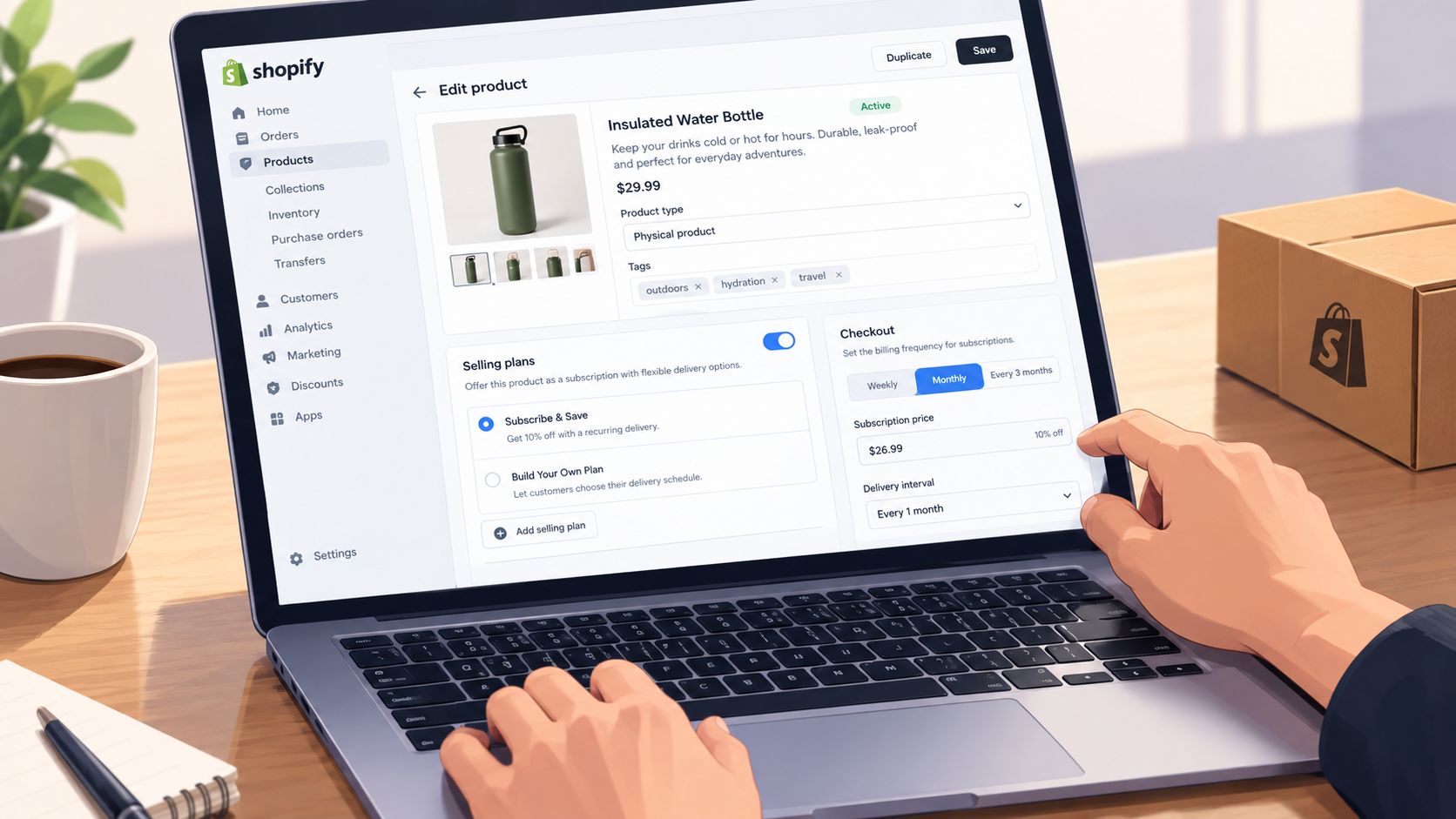
Install the chosen subscription app, connect its selling-plan integration, and create the subscription product or variant according to its requirements. Keep the structure clear for merchandising and inventory teams. A separate product often suits a fully curated box, while variants or plan selections can handle size, preferences, or delivery cadence.
Set delivery intervals only after checking fulfilment capacity. Each interval creates another forecasting and packing path. If the warehouse can reliably prepare a monthly box but struggles with staggered dates, limit the choices and make pause or skip options easy to use. Flexibility can protect retention without creating unnecessary operational work.
Set the recurring price, subscription incentive, and prepaid alternative with precise renewal language. Replace vague wording such as “automatic delivery” with the next charge timing and delivery expectation. Place the terms beside the purchase controls. Keep the one-off option visually distinct so customers do not select the wrong plan by accident.
Place and style the subscription selector carefully
On a Shopify 2.0 theme, place the subscription widget in the product information area, close to price, quantity, and add-to-cart controls. Match the store's typography, contrast, and spacing. On mobile, check that shoppers can see the plan choices before buying and read renewal terms without excessive scrolling.
Test every state. The page should respond correctly when a shopper changes the plan, selects a one-off purchase, applies an eligible discount, or chooses an unavailable variant. Test cart behaviour where one-time products can sit alongside recurring items, including any messaging that explains separate fulfilment or charges.
Subscription offers are becoming more common, so a generic widget and unclear proposition will do little to distinguish the box. The checkout should reinforce why the recurring commitment makes sense, particularly when customers can pause, skip, or modify future deliveries instead of cancelling.
Test payment and renewal communication
Run test orders through the actual theme, devices, and shipping rules. Review the cart, checkout, order confirmation, customer account, and internal fulfilment record. Confirm that the initial order and later renewal use consistent information about delivery timing, charges, tax treatment, and support routes.
Payment infrastructure needs its own review. Shopify payment processor integration guidance helps teams assess how payment events connect with subscription billing and downstream systems. Confirm what happens after a failed charge, a changed payment method, or an interrupted renewal.
Use a complete test script before launch:
- Plan selection: Verify that one-off and subscription choices are unmistakable.
- Discount logic: Check that discounts apply only where intended and do not stack unexpectedly.
- Address changes: Confirm whether subscribers can update the address before the next order.
- Failed payment: Test the customer message, retry path, and internal alert.
- Cancellation: Ensure the customer can find the action and receives an accurate confirmation.
- Pause and skip: Check that customers can choose these options without entering a cancellation flow.
- Plan changes: Verify that cadence, preferences, and the next charge update correctly.
The video below offers an additional visual reference for the configuration workflow.
Managing Inventory Fulfilment and Subscriber Self Service
Retention problems often begin in the warehouse. A box can have an excellent landing page and still lose subscribers when an item is substituted without explanation, the parcel misses its expected window or the next charge arrives before the customer has used the previous delivery.
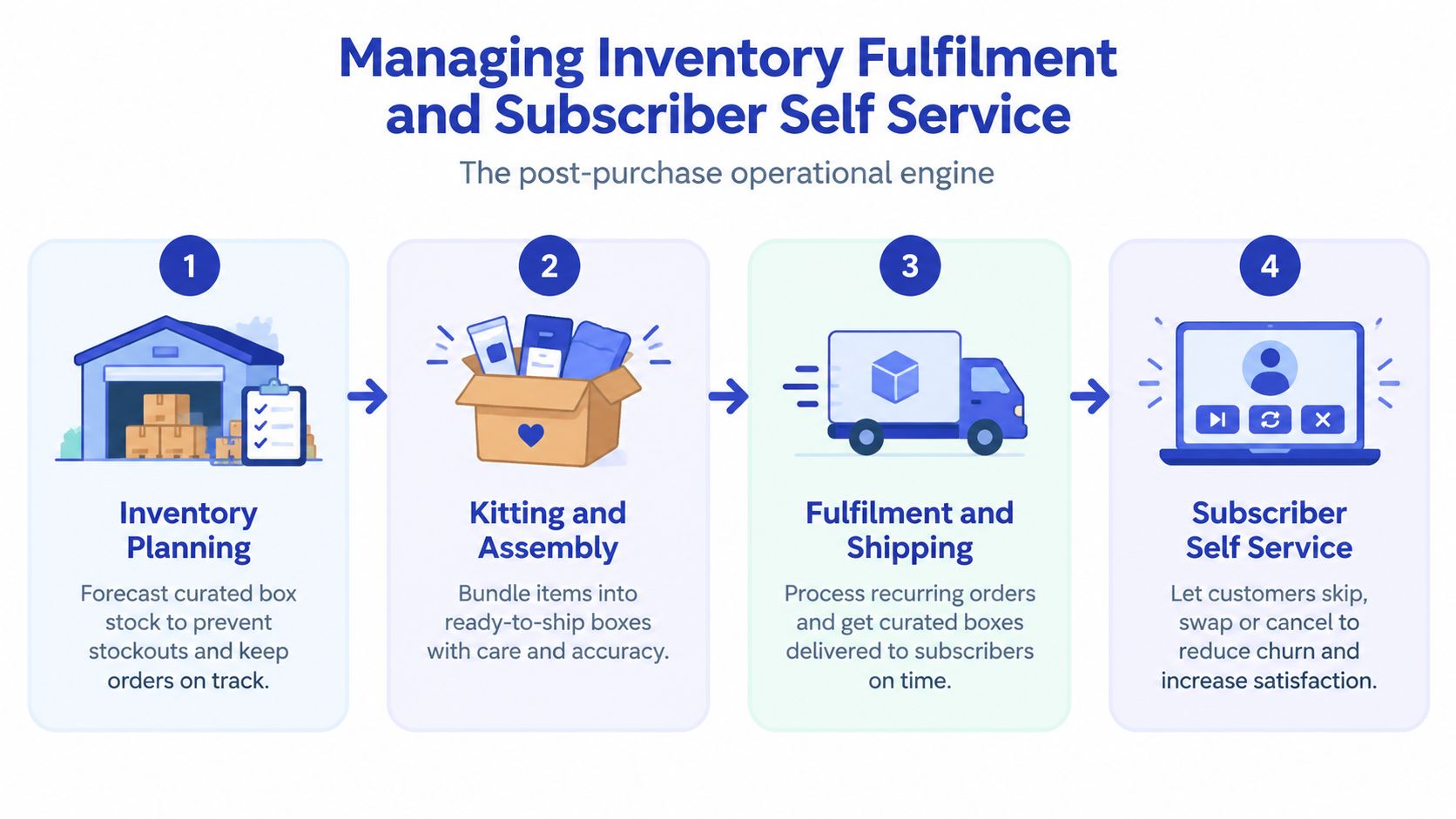
Treat inventory, fulfilment and account control as one operating loop. Demand planning should account for active contracts, likely pauses, swaps and acquisition campaigns. Curated boxes need component-level visibility, because the business may have enough finished stock but not enough of one key item to complete every promised box.
Make the warehouse subscription-aware
Set a cut-off for changes before each fulfilment run. The customer portal should show that cut-off clearly, while the operations team should receive a stable order file after it passes. Without this boundary, last-minute edits can create picking errors, duplicate shipments or stock allocated to the wrong customer.
Use a bill-of-materials view for every box configuration. The team needs to know which components belong in each plan, which substitutions are acceptable and which products require special handling. Kitting can reduce packing decisions on the line, but only if the kit contents are controlled and replenished before the next batch.
A 3PL or ERP integration should carry more than order numbers. Pass subscription identifiers, delivery dates, product preferences and skip status where the receiving system needs them. Record fulfilment exceptions in a way that customer service can understand without asking the warehouse to reconstruct the shipment.
Give customers a useful portal
The account area should make common actions self-explanatory:
- Pause the plan: Let customers choose a return date or leave the subscription paused until they reactivate it.
- Skip the next box: Offer a single-cycle skip without forcing a cancellation.
- Change frequency: Allow a slower cadence when the customer has too much product.
- Swap contents: Limit swaps to inventory-safe choices that the warehouse can fulfil.
- Update payment and address: Keep billing and delivery details available before the next renewal.
- Cancel clearly: Ask for a reason, present relevant alternatives, then complete cancellation without obstructive steps.
Failed payment recovery belongs in the same workflow. Send clear notices, provide a secure route to update payment details and define what happens to the order while retries are pending. A support team shouldn't have to manually inspect every failed renewal.
Customers often don't want to leave the brand. They want the current delivery to stop being inconvenient.
Age segmentation can sharpen retention work. Whistl research found that fewer than a quarter of shoppers intended to cancel soon, but cancellation intent reached 34.5% among people aged 55 to 64, while average subscription duration was about 9 months (Whistl subscription-box market report). That supports targeted messaging and retention options, not blanket discounts. Make pause, skip and product-control education especially visible before customers reach the point at which they consider cancelling.
Measure operational health alongside revenue. Track fulfilment accuracy, stockouts, failed payments, support contacts per renewal, portal actions and cancellation reasons. These signals tell you whether churn comes from the product, the promise, the payment system or the customer's lack of control.
Optimising Conversion and Retention for Long Term Growth
A Shopify subscription box converts when the customer understands both the immediate reward and the future commitment. Product photography and a launch discount may win the first order, but retention depends on whether the box remains relevant, predictable and easy to adjust.
UK coverage reports that 4 in 5 adults are signed up to at least one subscription service, 29% are in a subscription box, and the average consumer spends £58 a month on subscriptions (Whistl's UK subscription coverage). The same coverage highlights demand for easier ways to switch subscriptions on and off, customise them or cancel. Your conversion rate therefore depends partly on proving that the customer won't become trapped.
Prioritise the experience in this order
Start with the landing page. Show the box contents or selection logic, delivery cadence, recurring price, cancellation terms and flexibility controls before the purchase button. A quiz can improve relevance for discovery boxes, but it shouldn't delay the purchase or collect preferences the operation can't use.
Make the first delivery feel deliberate. A welcome note, usage guide or explanation of the curation helps the customer understand the value of the box. Don't add inserts to fill space. Each element should help the subscriber use the products, discover the next reason to stay or find support quickly.
Lifecycle communication should cover more than dispatch confirmation. Send renewal reminders where appropriate, explain upcoming contents, share usage ideas and make account actions prominent. Customers are less likely to cancel in frustration when they can change the next shipment before the charge.
- Test the promise: Compare clear value-led copy with discount-led copy.
- Test control placement: Put pause and skip information near the plan selector, account navigation and cancellation flow.
- Test onboarding: Compare a plain confirmation with a useful first-box guide.
- Test recovery: Create separate messages for failed payments, unwanted contents and delivery issues.
- Test cancellation alternatives: Present pause, slower delivery or a swap only when each option solves the stated reason.
For a practical framework covering the causes and measurement of recurring-revenue loss, the YipSMS Inc. churn guide is a useful resource to consult alongside your own cancellation data. Keep the retention programme simple enough to learn from. Subscription lifecycle management guidance can help organise onboarding, renewal, intervention and win-back journeys without scattering rules across disconnected tools.
The important measure isn't a single conversion result. Watch whether customers reach later renewals, whether portal usage prevents avoidable cancellations and whether support contacts fall as self-service improves. Extend the product experience beyond the parcel, and subscribers have more reasons to keep the relationship active.
Launching Your Shopify Subscription Box With Confidence
Launch only after the offer, billing and operations agree on the same promise. Validate the box concept, confirm margin after fulfilment and delivery, select an app that supports the required portal actions, configure selling plans, then test first order, renewal, payment failure, address change, skip, swap and cancellation journeys.
For the first operating period, monitor subscriber activation, renewal completion, failed payments, fulfilment accuracy, portal actions and cancellation reasons. Those measures will show whether customers need a better box, clearer communication or more control. Avoid launching with too many variants, unsupported swaps or a cancellation flow that depends on a support agent.
Bring in specialist Shopify support when the build involves a migration, custom billing logic, ERP or 3PL synchronisation, complex build-a-box rules or a headless customer portal. A clean foundation is cheaper to maintain than a collection of patches added after subscribers encounter problems.
Grumspot helps Shopify merchants design and implement subscription boxes, including native Subscription API builds, Recharge and Bold integrations, customer portals, migrations and retention-focused workflows. Visit Grumspot to discuss a subscription setup that connects checkout, fulfilment and subscriber control.
Let's build something together
If you like what you saw, let's jump on a quick call and discuss your project

Related posts
Check out some similar posts.
- shopify store credit
Learn how to set up Shopify store credit with built-in tools or apps. Covers policy design, refund w...
Read more
- unified commerce platform
Learn how a unified commerce platform connects channels, ERPs, and CRMs to drive growth. Practical g...
Read more
- composable commerce platform
Learn what a composable commerce platform is, how it differs from monoliths, and how UK Shopify Plus...
Read more
- b2b ecommerce platform
Discover how a B2B ecommerce platform helps scaling brands streamline operations, boost sales, and g...
Read more