Black Friday Campaigns: 7 Tools for Shopify Stores
- black friday campaigns
- Shopify marketing
- Black Friday email
- BFCM tools
- Shopify CRO
Launched
October, 2026
The sale goes live, the first promotional email lands late, and the homepage starts slowing under the traffic. Meanwhile, checkout fills with frustrated visitors because a payment method disappears or a limited product sells out before most customers can reach it. That's how Black Friday campaigns lose money, even when demand is strong.
A reliable Shopify stack gives each risk a clear owner. One tool builds the list and sends the messages. Another creates campaign pages. Another personalises discovery, while a traffic-control layer protects the storefront during a surge. The right choice depends on your team, budget, data maturity and lead time, not on how many features appear on a pricing page.
This roundup organises seven tools by the job they perform during the Black Friday window. Use it to identify the gaps in your current setup, then test the stack before customers arrive. If you're producing paid social creative as well, ShortGenius AI video ad maker can help your team prepare campaign assets faster.
1. Klaviyo
Klaviyo is the strongest all-round choice when email, SMS and behavioural segmentation sit at the centre of your Black Friday campaigns. Its Shopify integration pulls in browsing, cart, checkout and purchase activity, so your team can create journeys based on what customers do rather than relying on broad lists.
Set up VIP early access, browse abandonment, cart recovery, final-hours reminders and post-purchase win-backs in one account. Klaviyo also supports WhatsApp, RCS and push alongside email and SMS, with unified customer profiles. Its campaign Composer and prebuilt BFCM flows can shorten production time, but they still need human review for offer rules, exclusions and tone.
Where Klaviyo earns its place
The practical advantage is depth. You can exclude recent purchasers from acquisition offers, separate full-price customers from discount-led customers, and trigger messages from real-time shopping behaviour. Shopify Plus teams can also connect broader commerce data through Klaviyo's integration ecosystem.
Practical rule: Build the segments before you write the creative. A “VIP” audience should have a defined purchase or engagement rule, not just a memorable name.
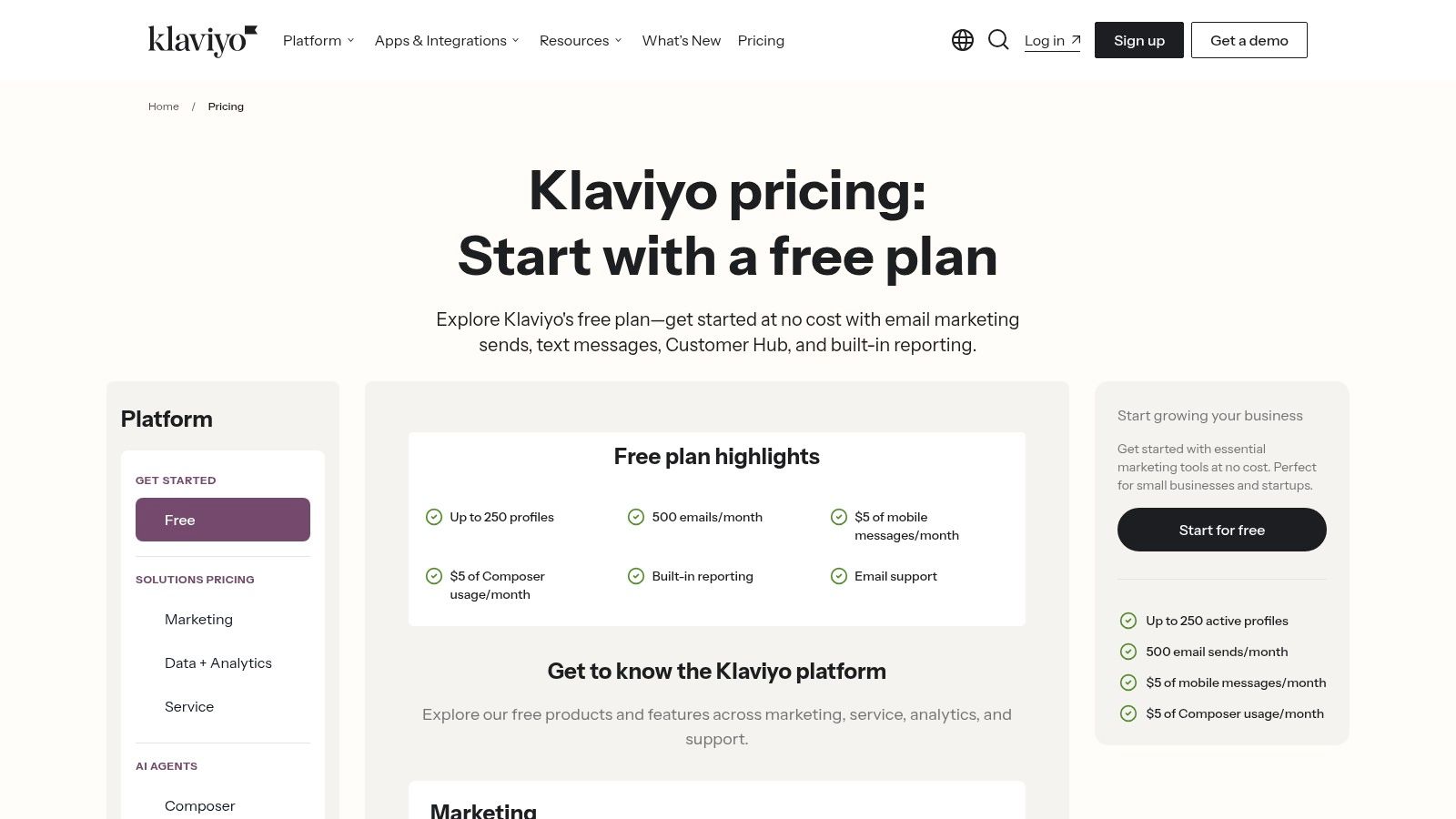
The free plan is useful for prototyping flows and testing the data connection, but it won't remove the need to budget for sending volume. SMS and WhatsApp costs vary by region, and the platform's wide feature set can slow a new team that hasn't assigned ownership.
Pricing and go-live timing
Check the Klaviyo pricing page against your expected email profiles, SMS volume and regional fees. Install the Shopify connection early, validate event tracking, suppress unqualified contacts and run test orders before launch. Give the team several weeks to build, approve and test the full journey.
Choose Klaviyo when you need mature segmentation and a broad Shopify ecosystem. Avoid using every channel just because it's available. A smaller, well-tested email and SMS programme will beat an ungoverned omnichannel schedule.
2. Omnisend
Omnisend suits DTC teams that want to launch quickly without building a heavy customer-data operation. Its interface is designed around ecommerce campaigns, and its BFCM resources provide templates, timing guidance and common automation patterns for merchants preparing under pressure.
The core setup is straightforward. Connect Shopify, import or validate consented contacts, create welcome and abandonment flows, then add your Black Friday segments. Web push gives you another owned channel, while SMS supports urgent reminders when customers have already shown intent.
A good fit for lean teams
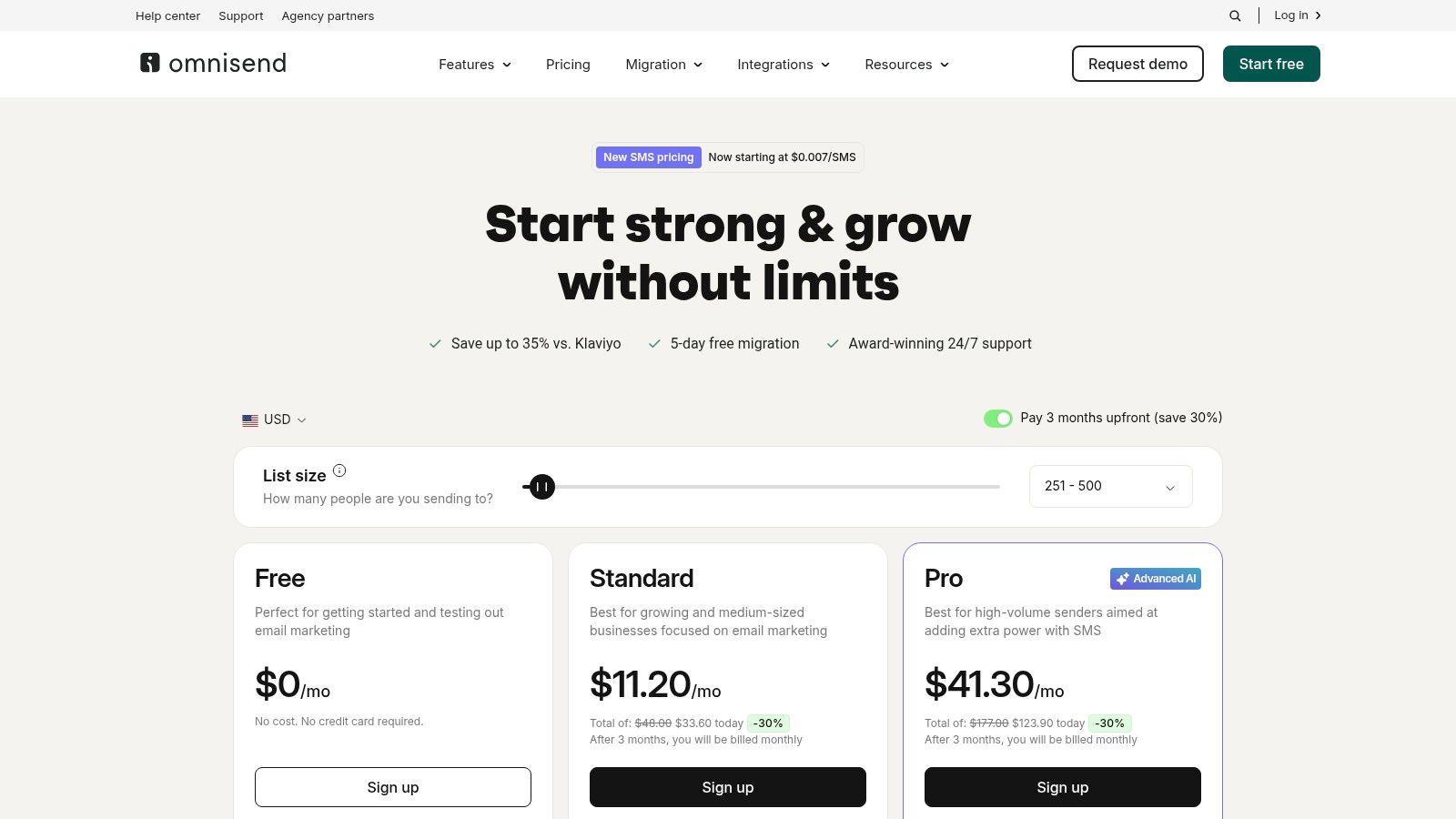
Omnisend's pricing page displays per-SMS rates, including an example of $0.007 per SMS, so teams can model message costs rather than treating SMS as an unexplained add-on. Verify the rate for your market and plan because regional charges and volume assumptions matter.
The platform also offers 24/7 live support, more than 300 integrations and guided migration options. That can be valuable if your current ESP is becoming difficult to manage before peak trading. Its ecommerce marketing automation guidance is also useful when you're mapping triggers and exclusions.
Keep the first version operationally simple. One clear promotional calendar, a small set of behaviour-based flows and strict frequency rules are easier to QA than a maze of overlapping automations.
Pricing and go-live timing
Review Omnisend's pricing by contact volume, SMS usage and the features your team will use. Start migration early enough to preserve historical data, verify consent and warm up sending infrastructure. A late migration leaves too little time to compare delivery, rendering and attribution with your existing platform.
Choose Omnisend when speed, support and transparent SMS planning matter more than advanced CDP-style data work. It may feel limiting if your organisation needs complex identity resolution or specialist business intelligence, but that extra complexity isn't automatically useful during a short promotional window.
3. Attentive
Attentive is built for brands that treat SMS as a primary Black Friday revenue channel, not as an occasional reminder service. It combines SMS and email identity, list-growth tools, AI Journeys and compliance support with strategic onboarding for larger campaigns.
That focus changes the implementation work. You'll need clear consent capture, mobile-friendly sign-up placements, frequency controls and a message hierarchy that distinguishes early access from a genuine last-chance alert. Attentive's billing tools expose message and carrier fees, which helps finance teams understand the cost of a high-volume programme.
Compliance is part of the build
SMS list growth can look attractive right up until the team discovers that consent records, regional rules and opt-out handling are incomplete. Attentive provides compliance tooling and guidance, but your team still owns the customer experience and the accuracy of its consent model.
Use zero-party data thoughtfully. Preference centres, product interests and stated shopping intent can improve targeting, but only if the forms explain what customers are sharing and how you'll use it. Zero-party data strategy guidance can help your team avoid collecting preferences that never influence a message.
Attentive's managed support is a real advantage for high-throughput events. It's less compelling for a small store that only needs occasional SMS sends and already has a capable email platform.
Pricing and go-live timing
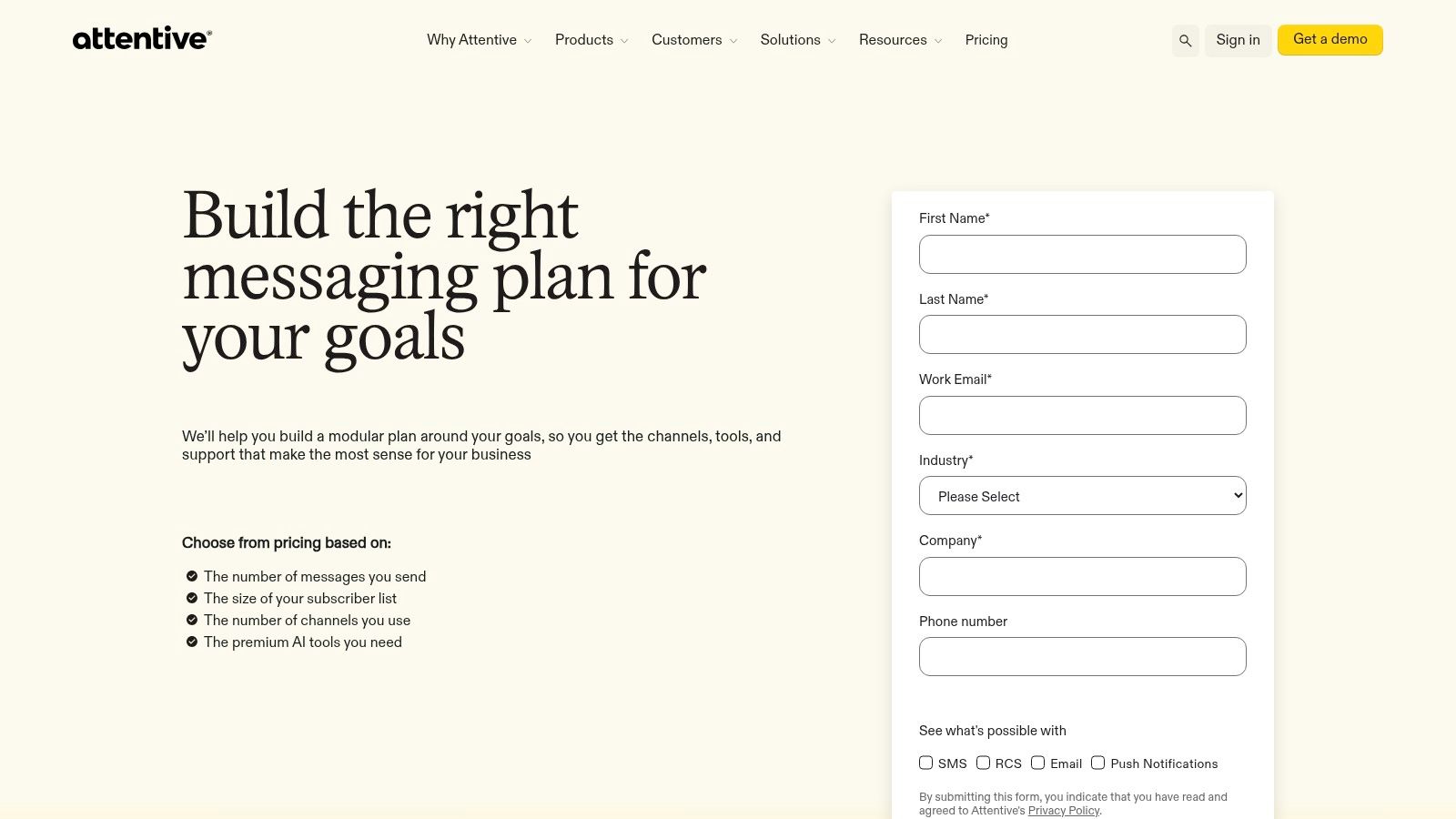
There's no public price list on the Attentive pricing page. Expect a sales-led process with quote-based pricing, contract terms and possible minimum commitments. Ask for the complete regional cost model, including carrier fees, onboarding, support and expected message volume.
Start discussions well before the campaign calendar is final. Attentive is best deployed when SMS strategy, list growth and compliance have time to mature. Choose it when the expected SMS programme justifies enterprise support. Don't select it for prestige if your team won't use the operating model.
4. Ometria
Ometria is the option for UK and European retailers that need customer data and lifecycle orchestration to work together. Its retail-focused model supports predictive segmentation and cross-channel campaign planning, making it suitable for VIP access, lapsed-customer reactivation and replenishment-led activity around the promotional season.
The distinction from a lightweight ESP is implementation depth. Ometria can help unify the information needed for more considered audience decisions, but your team must define the customer states that matter. Decide which customers qualify for early access, which lapsed buyers deserve a reactivation message and which product relationships justify a replenishment prompt.
Built for retail complexity
Ometria's UK roots and retail focus are useful when product ranges, stores, markets and customer histories create more complexity than a simple Shopify flow can handle. The platform can orchestrate email, paid and other channels from a shared customer view, which helps reduce contradictory offers.
The trade-off is weight. A retailer with fragmented systems may need data mapping, identity decisions, integration work and stakeholder sign-off before the first campaign is ready. That isn't a flaw, but it makes Ometria a poor last-minute purchase.
A data platform only improves Black Friday campaigns when the team agrees on the decisions it must support. Define the audience rules before asking for more predictions.
Pricing and go-live timing
Ometria's pricing is quote-based, so use the Ometria website to begin a commercial conversation and request implementation detail. Ask what data must be available from Shopify, CRM, paid media and fulfilment systems, then assign an owner for each connection.
Start months rather than weeks before launch if the data environment is complex. Choose Ometria when lifecycle strategy and customer unification justify the implementation. Choose a lighter ESP when the immediate requirement is dependable campaign execution with minimal technical dependency.
5. Replo
Replo handles the page-production problem. It gives marketing teams a visual way to build Shopify landing pages, gift guides, promotional collections and bundle pages without waiting for a complete theme-development cycle.
That matters during Black Friday campaigns because the offer often changes faster than the main storefront can be safely redeveloped. Build reusable sections for hero messaging, product groups, trust information, delivery terms and campaign-specific merchandising. Keep the content modular so the team can swap a product or offer without rebuilding the page.
Speed still needs governance
Replo's Online Store 2.0 compatibility and native Shopify fit reduce the need for heavy custom theme work. Its analytics can help your team monitor campaign-page behaviour, while its expert network provides an option when internal design or development capacity is tight.
The app dependency is the main trade-off. Every additional layer needs review for page speed, tracking, accessibility, responsive behaviour and compatibility with discounts, subscriptions and markets. A visually polished page that loads slowly or loses analytics events won't help your conversion rate.
Use a staging or unpublished version to test mobile layouts, product availability, discount application and checkout hand-off. Don't let multiple people edit live campaign pages without a release owner.
Pricing and go-live timing
Review Replo's pricing plans against the number of pages, collaborators and support requirements. Build the page system before the promotional creative is final, then freeze the core layout early enough for device and browser QA.
Replo is a strong choice when your team needs landing-page speed and Shopify-native deployment. It's less suitable as a complete experimentation platform. If you need advanced CRO testing, plan for an additional tool or a more controlled development process.
6. Nosto
Nosto improves what happens after a shopper arrives. It combines product recommendations, content personalisation, segmentation, AI Search and merchandising so customers can find relevant products when the catalogue and traffic both become difficult to manage.
For a Black Friday campaign, configure recommendations around margin, availability, category intent and complementary products. Don't promote a product aggressively if inventory is thin or fulfilment capacity is already constrained. Merchandising rules should reflect the commercial plan, not just maximise clicks.
Personalisation needs clean inputs
Nosto integrates with Shopify and Shopify Plus, and Shopify Markets support helps teams localise experiences across markets and currencies. AI Search can also reduce the friction caused by large catalogues, unclear synonyms and shoppers who arrive with a specific product need.
The implementation requires preparation. Audit product titles, descriptions, variants, availability, collections and merchandising priorities before enabling recommendations. Test what happens when a product sells out, a currency changes or a customer lands from a campaign with a specific offer.
Personalisation shouldn't mean showing every shopper more products. It should reduce the effort required to choose the right product.
Pricing and go-live timing
Nosto uses custom pricing, so begin with its pricing information and ask for the cost of the modules, markets, traffic profile and support model you need. Sales engagement is part of the buying process, and the team should budget for implementation and QA as well as the licence.
Start planning well before peak trading. Test recommendation placements, search results, fallback behaviour and analytics on mobile and desktop. Nosto is a good fit when product discovery and merchandising are limiting performance. It's unnecessary if the catalogue is small and the main problem is still a slow or unclear storefront.
7. Queue-it
Queue-it handles the risk that a sudden traffic spike overwhelms the store. Its virtual waiting room meters access, helps protect the website from automated abuse and gives shoppers a clear message while they wait.
This is especially useful for limited drops, scarce inventory and heavily promoted launches. Rather than allowing every visitor to refresh the same page, Queue-it controls admission and communicates queue status in a branded environment. That can protect both uptime and customer trust when demand arrives in a concentrated burst.
Traffic control is an operational decision
A waiting room won't fix poor product data, a broken discount or an unreliable fulfilment promise. It can, however, prevent your team from treating a capacity problem as a marketing problem. Decide which URLs need protection, when the queue activates, how visitors return to the store and what happens when stock changes.
Run a controlled test with your Shopify setup. Confirm analytics continuity, campaign parameters, login behaviour, cart persistence and mobile rendering. The wider Shopify performance optimisation guidance can help you identify other bottlenecks before adding traffic control.
Queue-it adds another system to configure, monitor and explain to support teams. It also uses quote-based pricing, so small merchants may find the cost difficult to justify unless a failed launch would carry serious commercial or reputational consequences.
Pricing and go-live timing
Use the Queue-it pricing page to start a quote request and ask about traffic assumptions, integrations, support and implementation. Secure the decision early enough to complete load testing and operational rehearsals.
Choose Queue-it when demand is concentrated or stock is strictly limited. Don't deploy a queue as a substitute for basic Shopify performance work. The best result is a controlled customer journey that protects access without creating unnecessary waiting.
Black Friday Campaigns: Top 7 Tools Comparison
| Solution | Implementation Complexity 🔄 | Resources & Speed ⚡ | Expected Outcomes 📊 / Quality ⭐ | Ideal Use Cases 💡 | Key Advantages |
|---|---|---|---|---|---|
| Klaviyo | Medium, broad feature set; moderate learning curve | Moderate, free testing plan; pay‑per‑message SMS/WhatsApp; fast Shopify deploy | ⭐⭐⭐⭐⭐, strong segmentation, targeted revenue uplift for BFCM | Omnichannel Shopify merchants scaling from startup to enterprise | Deep Shopify sync; prebuilt BFCM flows; unified profiles |
| Omnisend | Low, ecommerce‑first, quick setup | Low, transparent SMS rates; fast time‑to‑value | ⭐⭐⭐⭐, reliable uplift for DTC email+SMS campaigns | SMBs on Shopify needing rapid migration and cost clarity | Guided migrations; 24/7 support; BFCM templates & guidance |
| Attentive | Medium, enterprise onboarding and managed support | High, quote‑based, contracts/minimums; built for high SMS volume | ⭐⭐⭐⭐⭐, high impact when SMS is primary revenue channel | Large DTC brands running high‑throughput SMS BFCM pushes | Managed delivery & CSM support; AI Journeys; compliance tooling |
| Ometria | High, CDXP with heavier implementation and services | High, quote‑based; requires data integration and professional services | ⭐⭐⭐⭐, strong lifecycle/CRM uplift for retail use cases | UK/European retailers needing CDP + orchestration for complex lifecycles | Retail data model; cross‑channel orchestration; strong services |
| Replo | Low, visual builder, minimal theme development | Low, subscription; rapid page builds but QA required for performance | ⭐⭐⭐⭐, faster promo launches; improved on‑page conversion | Marketing teams needing fast BFCM landing pages and bundles | Fast time‑to‑launch; Online Store 2.0 compatibility; native analytics |
| Nosto | Medium, requires planning, QA for personalization | High, custom pricing; integration with Shopify Plus | ⭐⭐⭐⭐⭐, proven AOV and conversion uplift during spikes | Retailers seeking 1:1 product recommendations and AI search | AI recommendations; merchandising & search; localized experiences |
| Queue‑it | Medium, additional system to configure and test pre‑event | Medium, quote‑based; needs lead time to budget and integrate | ⭐⭐⭐⭐, protects uptime and conversion integrity under surge | High‑traffic drops, limited releases or high‑demand BFCM promotions | Fair queuing; bot mitigation; battle‑tested peak‑event protection |
Turn These Picks Into a Black Friday Calendar
Start with the job that creates the largest risk. Most Shopify stores need one dependable email or SMS platform first, not three overlapping customer-engagement systems. Choose Klaviyo or Omnisend for a fast, broad setup. Consider Attentive when SMS is a major channel with enterprise-level compliance and support needs. Choose Ometria when retail data, lifecycle orchestration and complex segmentation justify a heavier implementation.
Add Replo when campaign-page production is slowing the team down. Add Nosto when shoppers struggle to find relevant products or merchandising rules need to change by market, inventory position or intent. Add Queue-it only when a sudden traffic surge or limited drop creates a credible availability risk.
A workable calendar assigns deadlines to each layer:
- Data and consent: Validate Shopify events, customer properties, suppression rules and regional permissions before building the final journeys.
- Creative and landing pages: Produce reusable page modules, promotional assets, product information and delivery messaging early enough for mobile and accessibility QA.
- Personalisation and search: Test recommendations, search synonyms, out-of-stock fallbacks, currencies and collection rules before campaign traffic arrives.
- Traffic protection: Decide whether a queue is needed, then test admission, redirects, analytics and support messaging under controlled load.
- Launch rehearsal: Place test orders, apply every discount type, check payment methods, confirm emails and SMS, and verify fulfilment promises across devices.
Track contribution margin, conversion rate, average order value, units per order, returning-customer share, fulfilment cost and return behaviour by campaign day. A longer promotional window can hide weaker productivity if the team watches revenue alone. UK evidence shows why this matters. IMRG reported that Black Friday week revenue in 2025 declined year on year overall, while selected days grew, and Signifyd found higher average order value alongside fewer transactions in the same analysis. Read the IMRG Black Friday 2025 analysis before setting one blanket target for the whole week.
Audit your current stack against the seven jobs above. Mark each as covered, partially covered or exposed, then close the highest-risk gap before the first promotion goes live. For broader gift-led merchandising ideas, review these Dirt Cheap Product gift options and decide whether a bundle or curated landing page belongs in your plan.
Grumspot helps Shopify and Shopify Plus teams build, fix and scale storefronts before peak trading, from campaign landing pages and performance work to CRO, integrations and full rebuilds. If your Black Friday stack has gaps, visit Grumspot to plan the technical, UX and conversion work your store needs before launch.
Let's build something together
If you like what you saw, let's jump on a quick call and discuss your project

Related posts
Check out some similar posts.

- shopify website examples
Explore 7 Shopify website examples and learn the UX, conversion features, and practical lessons merc...
Read more
- zero party data
Learn what zero party data is, why it matters for ecommerce, and how to collect and use it for perso...
Read more
- cro best practices
Apply cro best practices to Shopify stores with 10 actionable tactics for testing, product pages, ch...
Read more
- social proof widgets
Learn how social proof widgets boost Shopify conversions. Discover types, placement strategies, perf...
Read more