Hiring a Shopify Plus SEO Agency: A Practical Guide
- shopify plus seo agency
- shopify seo
- plus agency
- seo guide
- ecommerce seo
Launched
September, 2026
Your Shopify Plus store is growing, but organic search is becoming harder to manage. A replatform is approaching, international markets are being added, product variants are multiplying, and the monthly report still leads with sessions rather than revenue. Your existing agency may be competent at title tags and blog calendars, yet unable to explain which filtered URLs should be indexed, how a theme refactor affects canonicals, or who owns redirect QA on launch day.
That's the point at which hiring a Shopify Plus SEO agency becomes a commercial decision, not a supplier search. The UK online retail market reached £127.41 billion in 2024, up from £123.3 billion in 2023, and is projected to reach £286 billion by the end of 2025, according to UK ecommerce market data. Online channels already represented 28% of all UK retail sales, so organic visibility sits inside a major revenue channel, not a side project.
When a Shopify Plus Brand Needs a Specialist Agency
A mid-market retailer often reaches Shopify Plus after outgrowing a simpler operating model. The catalogue has expanded, a new market is being considered, and the development team is busy keeping merchandising, fulfilment, and integrations stable. The SEO agency that once handled metadata now receives requests involving URL changes, JavaScript-rendered content, regional storefronts, and product-filter behaviour. Its answer is usually another audit document.
That response creates risk. Shopify Plus launched in 2014 as a premium tier for larger retailers, and the platform now has a substantial UK footprint. One 2024 analysis reported more than 169,000 live Shopify stores in the UK, including 2,800 UK-based Shopify Plus websites. The same analysis recorded UK Shopify store growth of 8.3% quarter-on-quarter in Q3 2023 and 41% year-on-year. Those figures appear in UK Shopify adoption analysis, and they point to a crowded, technically mature search environment.
The complexity sits beneath the storefront
Shopify Plus gives enterprise teams more flexibility, but flexibility creates more places for SEO signals to conflict. Liquid themes, theme.liquid, product and collection templates, app-generated filters, internal search, structured data, Shopify Markets, and headless builds all need to work together. A specialist should know how a seemingly harmless app installation can create crawlable variants, how a theme change can remove schema, and how an international configuration can produce competing canonicals.
The need becomes urgent during a migration. An old category URL may carry links and rankings that the new collection structure doesn't naturally preserve. A product may move to a new handle, a discontinued item may lose its equivalent, or a development environment may become crawlable before launch. These aren't cosmetic defects. They can weaken discoverability and conversion paths at the same time.
Commercial rule: Bring in a specialist when the next SEO mistake could affect a migration, a major market launch, or a high-value catalogue structure.
A credible partner should combine Shopify Plus implementation knowledge, enterprise ecommerce experience, analytics discipline, and stakeholder management. Review Shopify Plus partner agency guidance, but don't select a provider because of partner status alone. Choose the team that can show who will inspect the architecture, implement fixes, validate the release, and explain the commercial consequence of each priority.
The Evaluation Criteria That Actually Matter
Score every candidate against the same evidence. A simple 1 to 5 scale works well, but reserve the highest score for proof you can verify, not a polished presentation.
Score platform fluency first
Ask for examples involving Shopify Plus migrations, Liquid changes, app-driven catalogue behaviour, Shopify Markets, and constraints around checkout customisation. Don't accept “we work with Shopify” as evidence of Plus expertise. Ask which people performed the work, whether a developer was involved, and what changed in the theme or store architecture.
Then test technical depth. A serious agency should explain its approach to:
- Faceted navigation: Which filters create useful landing pages, and which should remain out of the index?
- Canonical architecture: How will product, collection, variant, parameter, and market signals interact?
- Rendering: How will the team check content and structured data that depend on JavaScript?
- Crawl control: Which low-value URLs are blocked, canonicalised, or allowed to remain indexable?
- Migration mapping: How will every important old URL receive one relevant destination?
- Schema and sitemaps: Who validates structured data and the XML sitemap after deployment?
The difficult question isn't whether an agency knows canonical tags. It's whether it can decide when a filtered UK collection deserves a search landing page because it matches demand and supports conversion, rather than applying noindex to every filter by default.
Test commercial and measurement discipline
References should confirm that the agency communicates clearly, prioritises revenue, and reports risks early. Require a named account owner, named delivery team, an escalation route, and a defined meeting cadence. A rotating account pool is not enterprise support.
Measurement should connect non-brand clicks, rankings, organic sessions, indexable URL health, product visibility, conversion rate, transactions, and organic revenue. The agency also needs to distinguish genuine organic growth from cannibalisation, attribution changes, and paid-brand spillover.
International capability deserves its own test. A proposal should address market-domain strategy, hreflang, localised content, canonical relationships, and governance between marketing and development. Broad awards and first-page guarantees matter less than recent, technically detailed Plus work. For a wider view of supplier selection, compare this with UK ecommerce SEO agency criteria.
Use an evidence-led scorecard
| Criterion | Suggested Weight | Evidence to Request |
|---|---|---|
| Shopify Plus depth | High | Named migration, Liquid, Markets, app, or headless examples |
| Technical ecommerce SEO | High | Audit sample covering faceting, rendering, canonicals, schema, and sitemaps |
| Migration governance | High | Redirect map, QA process, launch checklist, and monitoring plan |
| Commercial alignment | High | References, reporting examples, ownership model, and escalation process |
| International SEO | Medium | Market architecture, hreflang approach, and localisation workflow |
| Implementation capability | High | Named developers, access model, release process, and acceptance criteria |
Pricing Models and What They Really Include
The lowest retainer often wins the pitch and loses the engagement. Shopify Plus SEO work becomes expensive when “SEO” excludes developer time, content production, migration QA, tool access, or the meetings needed to secure approvals.
Retainers buy capacity, not unlimited output
A fixed monthly retainer usually covers an agreed mix of strategy, technical recommendations, content, authority work, reporting, and account management. It offers predictable budgeting, but the contract must state capacity and deliverables. Ask how the team handles a migration backlog that exceeds the monthly allowance, who pays for implementation, and whether unused hours carry forward.
A project model suits a defined outcome, such as a replatform migration, international launch, technical remediation, or SEO foundation. It creates clearer acceptance criteria, but vague scope turns into change requests. Specify developer responsibilities, redirect mapping, testing, launch support, post-launch monitoring, and the definition of completion.
Performance or hybrid pricing can align incentives around non-brand organic revenue, qualified transactions, or visibility. It can't make an agency responsible for inventory, pricing, promotions, seasonality, algorithm changes, or attribution quality. Treat variable compensation as a reward for accountable execution, not a purchase of rankings.
Pricing rule: Compare the effective cost of the work you need, not the headline monthly fee.
Normalise every proposal
Build a cost sheet with separate lines for:
- Strategy and analysis: Audit depth, roadmap creation, prioritisation, and stakeholder workshops.
- Technical delivery: Developer hours, theme work, app investigation, QA, and release support.
- Content: Research, briefs, writing, editing, localisation, and publishing.
- Authority: Digital PR, outreach, placements, asset creation, and approval time.
- Reporting: Dashboards, calls, commentary, and executive summaries.
- Tools and licences: Crawlers, rank tracking, backlink platforms, and data connectors.
Look closely at vague terms such as “optimisation”, “authority building”, and “content support”. If the proposal doesn't define the output, quantity, owner, and approval path, the line has little procurement value. A practical benchmark for framing the discussion is this SEO audit cost guide, but your store's architecture and implementation burden should determine the final scope.
The contract also needs termination notice, minimum term, renewal increases, ownership of content and accounts, data access, subcontracting rules, change-request pricing, and service credits. A cheap retainer dependent on unpriced development work is not cheap.
Shortlisting and the Discovery Call Questions
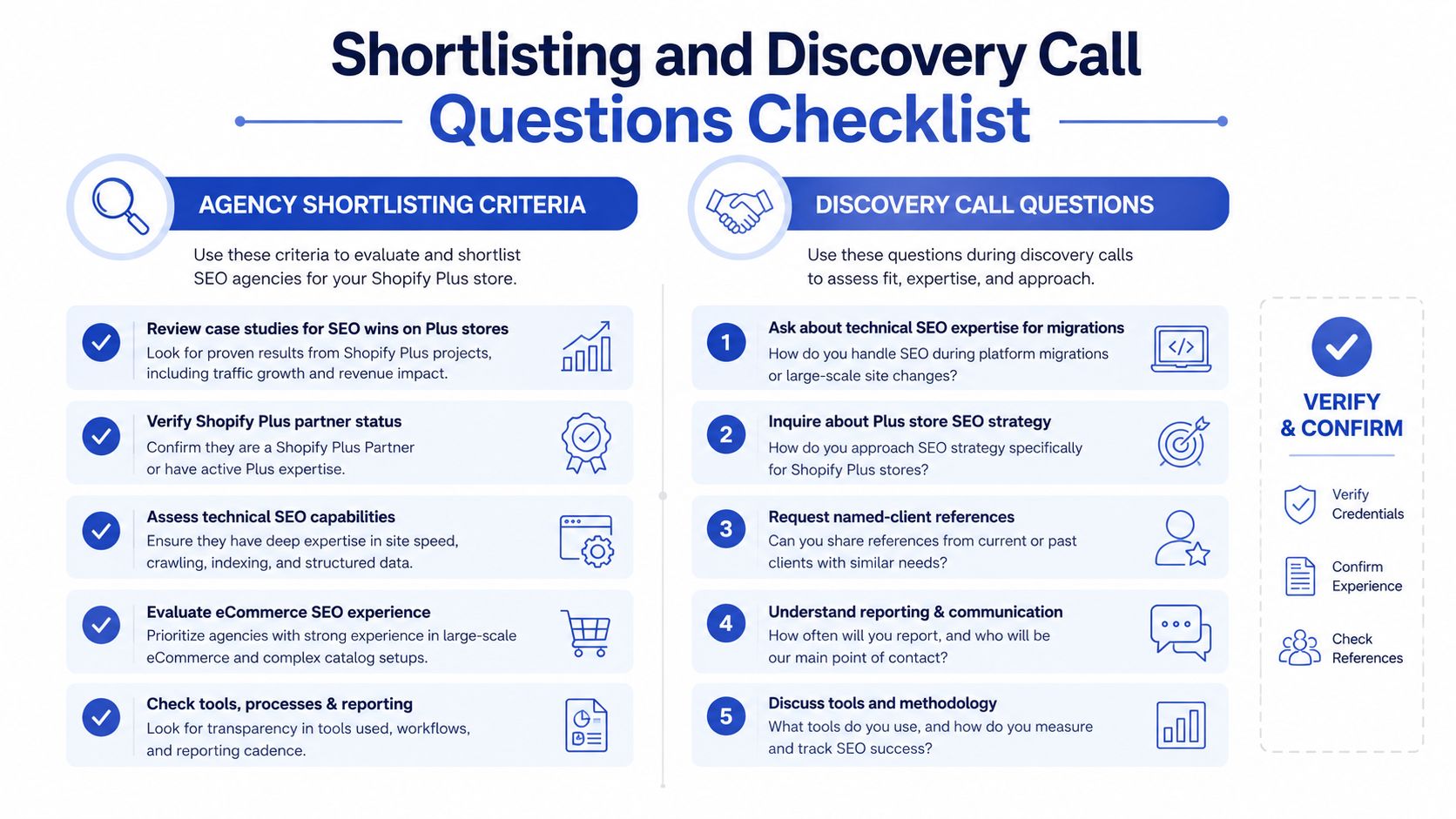
Start with three to five agencies. Review recent case studies on Plus stores, verify Shopify Plus partner status where relevant, and request named-client references. A portfolio full of attractive storefronts proves design ability, not SEO competence.
Treat the discovery call as a technical interview. Send a short outline of your catalogue, markets, current platform, planned releases, and known problems in advance. The best agencies arrive with sharper questions about templates, URL generation, apps, analytics, and ownership.
Questions that expose real experience
Ask:
“Show us a Shopify Plus migration you personally delivered. What changed, and how did you validate redirects, canonicals, sitemaps, and analytics?”
Look for a specific process, not a claim that the platform is SEO-friendly.“How would you assess our faceted navigation?”
A strong answer discusses search demand, crawl efficiency, internal linking, canonical signals, and conversion value. A weak answer says all filters should be blocked.“Who will modify
theme.liquid, templates, or structured data?”
You need to know whether recommendations reach production or remain in a document.“How do you handle Shopify Markets and hreflang?”
Listen for market architecture, localisation, canonical consistency, and testing across regional URLs.“What's your view on script tags, checkout constraints, and headless Hydrogen?”
The agency doesn't need to build every architecture, but it must know where SEO risk can appear.“What does your technical audit include, and how do you prioritise fixes?”
Request the crawl tooling, evidence fields, severity logic, and commercial prioritisation method.“Who writes and publishes content, and do you subcontract?”
Ask for editorial controls, subject-matter review, localisation, and publishing ownership.“Can we see a sample 90-day roadmap and a redacted report?”
The roadmap should have owners, dependencies, milestones, and measurable outcomes.
Request team continuity and escalation details before signing. Vague language about “holistic growth” usually signals a generalist offer. Specific answers about URL classes, templates, releases, and QA signal operational maturity.
KPIs, Reporting, and the First 90 Days
A useful SEO contract starts with a baseline, not a promise. During the first week, the agency should document organic revenue, non-brand clicks, rankings, indexable URL health, and template-level performance. Segment the view by product category, collection, product template, market, and device where the data supports it.
Traffic alone is a weak executive KPI. A store can gain sessions while valuable collection pages lose visibility, or record more clicks because branded demand increased. Your reporting should show whether search exposure reaches commercially useful pages and whether those visits produce transactions and revenue.
Establish ownership before the roadmap
Shopify Plus changes often require collaboration between SEO, development, merchandising, analytics, and legal or international teams. Assign an owner for implementation, an approver for content, and a decision-maker for prioritisation. If the agency only supplies recommendations, state who converts them into tickets and who confirms release completion.
The first 90 days should create visible operating rhythm:
- Days 1 to 30: Audit crawl and indexation, establish baselines, identify template risks, confirm analytics and Search Console access, and prioritise revenue-critical fixes.
- Days 31 to 60: Implement agreed technical changes, repair internal linking, improve collection and product templates, validate schema, and prepare content or authority work.
- Days 61 to 90: Monitor released changes, resolve defects, publish priority assets, review market and filter behaviour, and decide whether the strategy needs adjustment.
Reporting standard: Every recommendation should have an owner, a reason, a priority, an expected signal, and a way to verify completion.
Make cadence part of the agreement
| Phase | Focus Areas | Primary KPIs | Reporting Cadence |
|---|---|---|---|
| Baseline | Analytics, Search Console, crawl, templates | Organic revenue, non-brand clicks, indexable URLs | Initial audit and weekly working updates |
| First implementation | Technical debt and priority templates | Indexation health, errors, Core Web Vitals, ranking movement | Weekly delivery review |
| Content and architecture | Collections, products, internal links | Non-brand visibility, qualified clicks, conversion rate | Fortnightly performance review |
| Day 90 review | Commercial impact and next priorities | Transactions, revenue, category performance, unresolved risks | Executive review and roadmap reset |
Require access to Search Console, GA4 or the relevant analytics platform, Ahrefs or Semrush, and the rank-tracking configuration. The agency should explain what triggers a strategy review, what counts as routine optimisation, and how it will report a migration regression.
Where General SEO Agencies Fall Short on Shopify Plus
The assumption that any good SEO agency can handle Shopify Plus is wrong. General SEO knowledge remains useful, but the platform creates failure points that a broad checklist won't reveal.
Facets demand judgement, not blanket blocking
Large catalogues generate combinations through tags, vendors, filters, and collection variants. A generalist may respond by applying noindex widely, which can remove useful category demand along with low-value duplicates. A Plus specialist should classify filtered pages according to search intent, catalogue depth, internal linking, market setup, schema, and commercial value.
That question is especially important in the UK, where a retailer may need to decide whether a filtered page deserves indexation in one market but not another. Canonical tags alone won't resolve a poor information architecture.
Migrations expose the difference
Magento, BigCommerce, WooCommerce, and Shopify generate different product and collection paths. A team without migration experience may create redirect chains, point several old URLs to one irrelevant destination, or remove pages without equivalents. It may also overlook development blocking, broken analytics, structured-data loss, or post-launch Core Web Vitals regressions.
UK migration guidance records a harsh benchmark. Only 10% of migrations improve SEO performance, while the remaining 90% are flat or worse, according to Shopify's enterprise replatforming guidance. The same source reports an average recovery time of 523 days across 892 domain migrations, and says 17% never recover. Those figures make migration QA a revenue-risk control, not a design handover.
International and performance blind spots
Shopify Markets, localised domains, currency presentation, hreflang, and canonical relationships need coordinated governance. Headless Hydrogen builds and JavaScript-rendered content need rendering validation. Script-heavy apps can create performance and crawl issues that a link-building team won't detect.
If your marketing team also explores adjacent formats, a practical resource such as this cinematic AI video blog can help with creative production thinking, but it doesn't replace technical SEO ownership. Strong authority campaigns still underperform when critical collection and product pages aren't efficiently crawled or indexed.
A Real Hiring Scenario and Your Final Checklist
Consider an apparel brand moving from Magento to Shopify Plus. The launch looked polished, but organic traffic fell 40%, and the brand hired a specialist for a six-month recovery engagement. Non-brand sessions later increased 62%. Those figures belong to the scenario provided for this brief, not to a general benchmark, and they illustrate why the hiring decision should focus on recovery mechanics rather than presentation quality.
The team required a crawl and URL export, a one-to-one redirect map, canonical and faceted-navigation rules, template checks, content preservation, analytics verification, and post-launch monitoring. Two agencies reached the final round. The deciding question was simple: how would each candidate handle faceted URLs and canonical tags during a theme refactor?
One candidate offered a generic “technical SEO best practice” package. The other separated indexable category opportunities from low-value combinations, connected those decisions to internal linking and conversion intent, and described how it would test the changes before and after release. That specificity won the work.
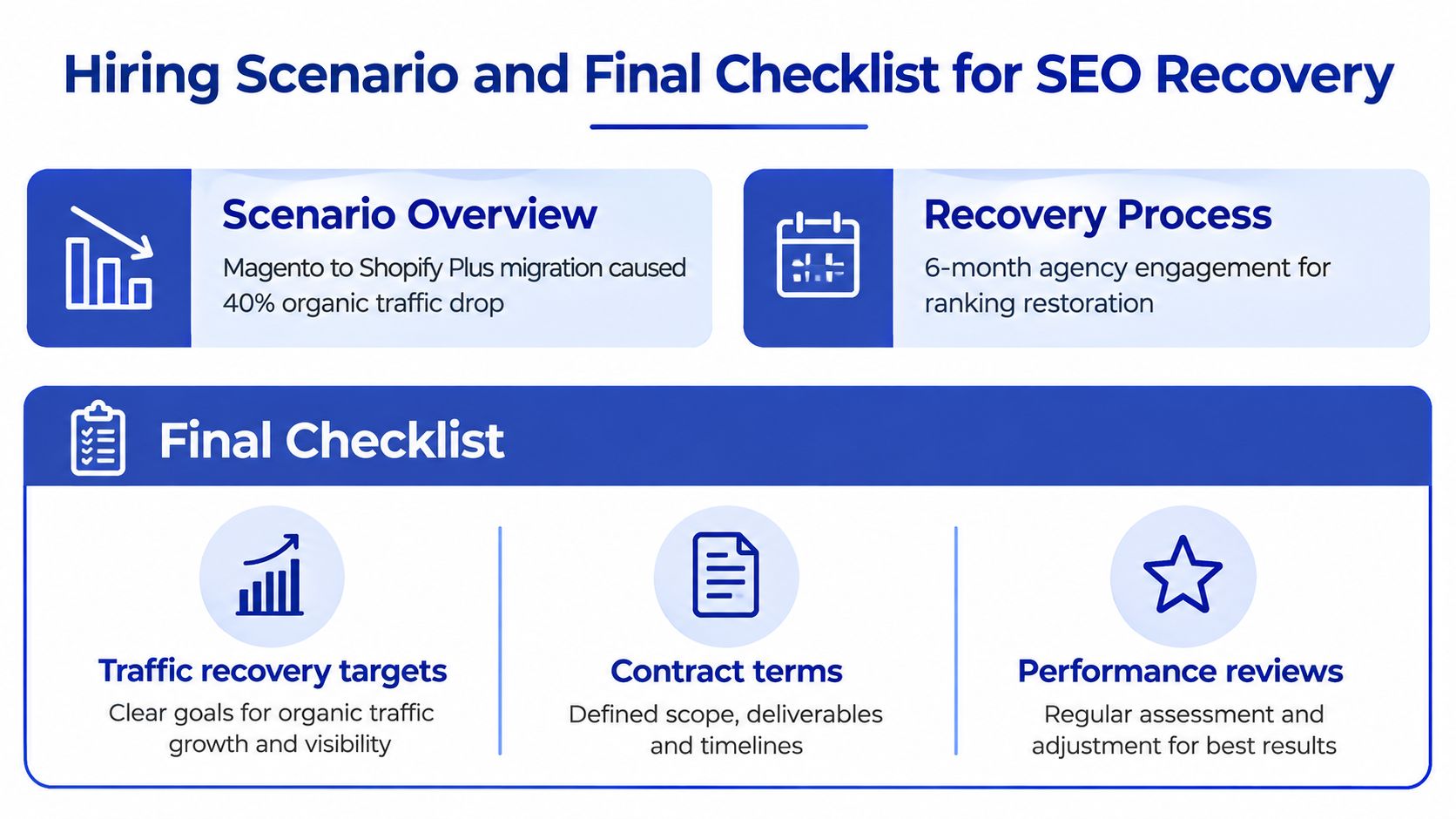
Use this final checklist before signing:
- Platform proof: Verify Plus-specific migrations, Liquid, Markets, apps, or headless experience.
- Case-study depth: Request deliverables, responsibilities, and measurable commercial context.
- Pricing clarity: Separate strategy, development, content, authority, tools, and reporting.
- Reporting cadence: Agree baselines, owners, segments, access, and review dates.
- Technical ownership: Confirm who implements, tests, approves, and fixes defects.
- Content integration: Connect collection, product, editorial, and conversion priorities.
- International scope: Define market URLs, localisation, hreflang, canonicals, and governance.
- Exit protection: Include a 90-day exit clause if the agency won't accept a practical early review.
The migration benchmark above shows why recovery planning must be explicit. For a concise visual recap of the hiring and recovery process, use the embedded video below.
Don't choose the agency with the glossiest deck. Choose the one that can inspect your Shopify Plus architecture, explain its decisions in commercial terms, implement the work with your developers, and prove what changed.
Grumspot provides Shopify and Shopify Plus SEO audits, migration support, technical implementation, and conversion-focused storefront work, including URL, metadata, redirect, structured-data, canonical, and sitemap considerations. If your next release or replatform carries organic revenue risk, visit Grumspot to discuss a practical audit and delivery plan.
Let's build something together
If you like what you saw, let's jump on a quick call and discuss your project

Related posts
Check out some similar posts.
- help center shopify
Learn how to build a help center Shopify merchants trust. Covers native pages vs apps, article struc...
Read more
- shopify seo
Choosing the right SEO app for Shopify means weighing features against speed, scripts, and plan limi...
Read more
- ecommerce seo agency uk
Learn how to pick the right ecommerce SEO agency UK with our practical guide covering services, pric...
Read more
- keyword research for ecommerce
Unlock revenue with our 2026 guide on keyword research for ecommerce. Learn to find, map & prioritiz...
Read more