Product Bundling Strategy That Lifts AOV Without Killing
- product bundling strategy
- AOV growth
- Shopify bundles
- ecommerce CRO
- bundle pricing
Launched
August, 2026
A product bundling strategy can raise average order value by 20% to 30%, and some ecommerce analyses report 20% sales gains with 30% profit gains when bundles are built well, but those numbers only matter if the discount doesn't destroy margin and the returns rate doesn't eat the upside bundling analysis. That's the core question for UK Shopify merchants in 2026, not whether bundles can work in theory. Bundling is a pricing and merchandising decision first, a UX decision second, and a technical build third.
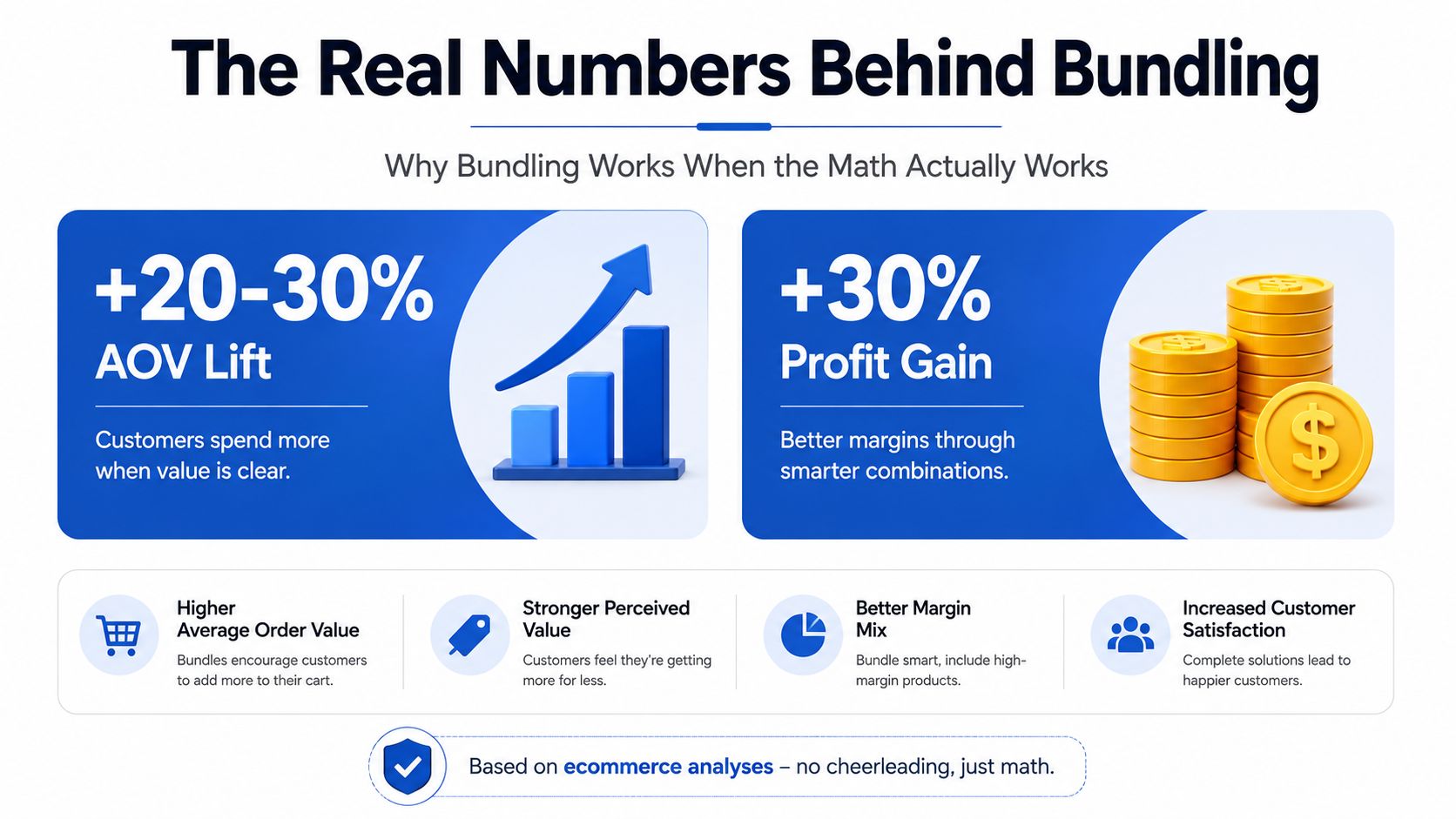
The stores that win with bundles don't chase bigger baskets blindly. They set a margin floor, watch returns like a hawk, and only discount as far as the unit economics allow. If the bundle looks impressive in a dashboard but bleeds on fulfilment and returns, it's not growth, it's leakage.
For a deeper view on the revenue side of the equation, this guide to increasing average order value is a useful companion read.
Why Bundling Works When the Math Holds Up
Bundling works when it changes transaction economics, not just presentation. A customer who buys a curated set usually lifts basket size, and ecommerce analyses commonly show stronger average order values when the offer is structured properly. That upside is real, but it only matters if the bundle holds its margin after discounting, fulfilment, and returns.
The upside is real, but it has a floor
The floor is where most bundle strategies fail. If the discount is too deep, the extra units do not make up for the lost margin. If the bundle attracts the wrong mix of orders, returns can wipe out the gain even when headline AOV looks healthy.
Practical rule: treat bundling as a margin test, not a merchandising hunch. If the offer cannot survive a conservative return scenario, it is not ready.
The commercial case is strongest when the bundle helps shoppers finish a task or solve a use case. That is why product bundling has stayed relevant for so long, from pre-ecommerce retail through to modern Shopify stores. The mechanic is simple, but the commercial effect is layered, more units per transaction, less need to buy traffic just to grow revenue, and a better shot at margin efficiency.
What the article is really optimising for
UK retailers do not need another generic “bundle more” pitch. They need a method that protects profit while raising basket value, especially when traffic costs are stubborn and fulfilment costs do not care how nice the promotion looks. The best bundles are built on three questions: will buyers want these items together, does the bundle price leave enough margin, and will returns stay manageable once the order is in the wild?
For a deeper view on the revenue side of the equation, this guide to increasing average order value is a useful companion read.
The commercial case is clear. The execution is where most merchants stumble.
Finding the Right Products to Bundle
The cleanest starting point is basket analysis on your own transaction data. Export Shopify orders, group products by co-purchase behaviour, and look for items that appear together often enough to justify a bundle test. The useful signal is not “these two products look nice together”, it's “these two products already share buying behaviour.”
Start with co-purchase frequency, then filter for margin
A practical threshold is products that pair in about 5% to 10% of carts, which is a strong signal worth testing rather than assuming co-purchase guidance. That number doesn't mean “ship it as a bundle”. It means shortlist it. After that, check the margin profile of each component, because a popular pair can still be a bad bundle if one SKU carries too much cost pressure.
Then validate inventory depth. If one component is thin and the other is abundant, the bundle becomes an operational problem before it becomes a commercial one. I've seen merchants build bundles around a strong hero product and forget that the add-on SKU is the actual constraint. The bundle sells, then stockouts start, and support has to clean up the mess.
Only shortlist products that can survive both demand and fulfilment pressure. A bundle that sells out unevenly is a planning failure, not a merchandising win.
Use the data to avoid sentimental bundles
Shoppers don't care that a merchandiser likes a pairing. They care whether the bundle solves a real purchase job. That means you should be looking for complementarity, repeatability, and a sane returns profile, especially in categories where fit or compatibility matters.
The simplest workflow is this:
- Export order history: Pull enough recent Shopify data to spot repeat combinations.
- Rank co-purchases: Look for pairs and small groups that recur naturally.
- Check gross margin: Drop anything that can't absorb a modest discount.
- Review stock depth: Make sure both components can support the same promotional window.
- Look at returns history: If one item regularly comes back, keep it out of the first wave.
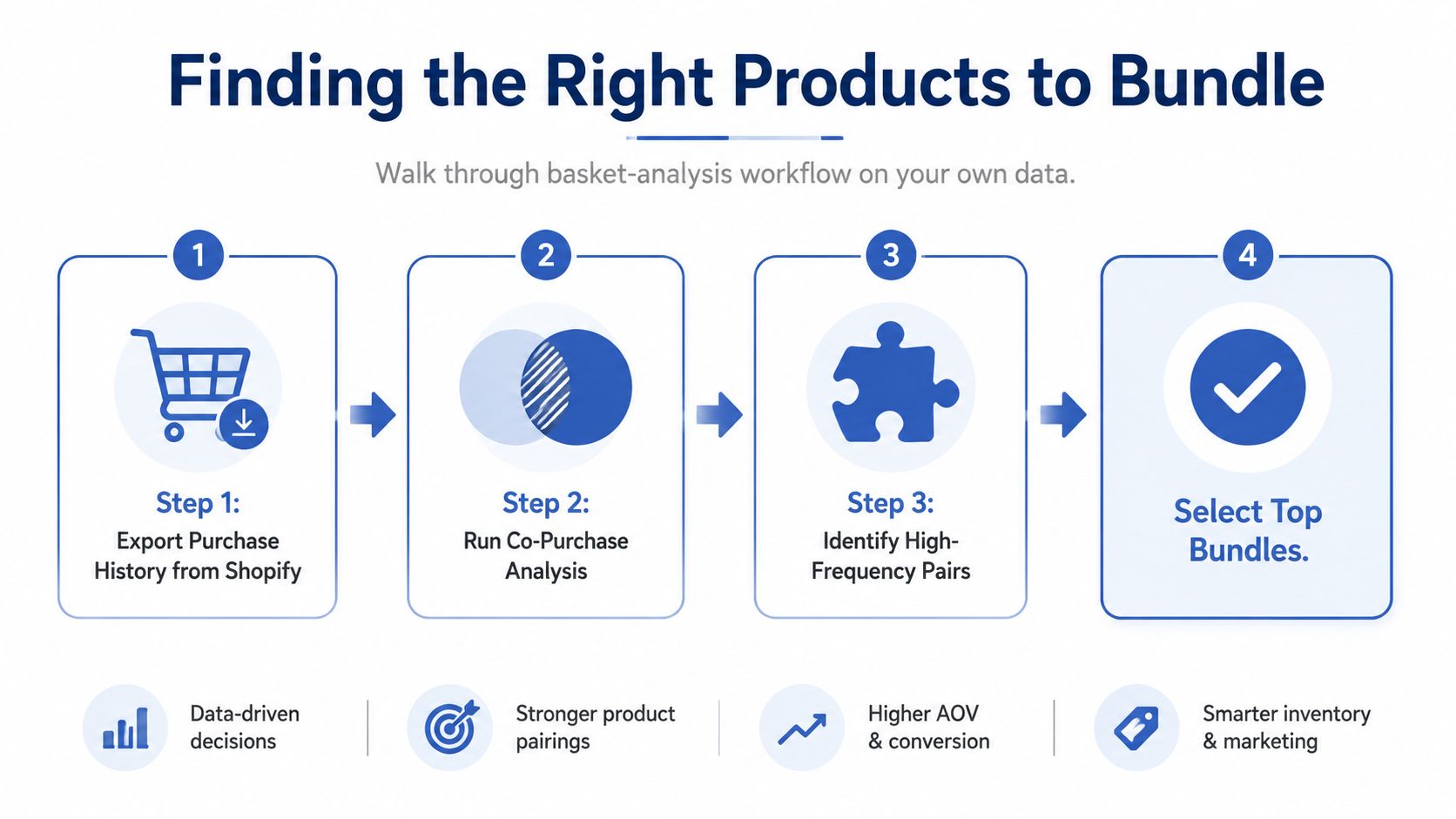
That shortlist gives merchandising something defensible. It also gives engineering a finite scope instead of a wish list of fifty “maybe bundles” that never get tested properly.
Choosing the Right Bundle Structure for Your Shoppers
Not every bundle should behave the same way in the storefront. A fixed set, a mixed bundle, and a quantity-discount bundle each solve a different shopper problem, and the wrong structure creates friction very quickly. The right choice depends on how much control the customer wants, how complex the category is, and how much operational variation you can support.
Fixed bundles work when the use case is obvious
A fixed bundle is the most opinionated version. You pre-select the items, package them as a set, and keep the decision path short. That works well when shoppers want speed, not configuration, especially for starter kits, replenishment packs, and obvious accessory combinations.
The risk is obvious too. If the shopper wants to swap one component, change delivery timing, or choose a variant, the fixed set can feel rigid. In those cases, the bundle can underperform even when the commercial logic is sound, because shoppers value control almost as much as price.
Mixed bundles are often the safer middle ground
A mixed bundle keeps the bundle offer but leaves individual SKUs available alongside it. This is the structure I reach for when the category has enough variation that a forced set would feel too prescriptive. It gives the merchant the bundle story, while still letting the customer opt out of one component if needed.
That configurability matters in mature UK ecommerce environments where shoppers compare total basket value carefully and don't always want a locked-in package. If the shopper is trying to control composition, delivery timing, or subscription alignment, a mixed approach usually fits better than a rigid set.
Quantity discounts suit repeat purchase behaviour
Quantity-discount bundles are less about curation and more about volume. They work when the same item or a narrow group of items gets reordered often, and the customer responds to “buy more, save more” rather than a curated package. That's a different mental model from fixed bundles, and it should be treated that way in the UX.
| Bundle structure | Best fit | Main strength | Main trade-off |
|---|---|---|---|
| Fixed bundle | Clear use cases, starter kits | Simple decision path | Less flexibility |
| Mixed bundle | Categories with choice and variation | Balances control and upsell | Slightly more UX complexity |
| Quantity discount | Reorder-heavy items | Encourages volume | Weak for curated discovery |
The point isn't to crown one winner. It's to match the offer shape to shopper behaviour and category reality. If the structure fights the way people buy, the discount has to work much harder than it should.
Pricing Bundles for Margin, Not Just Conversion
Most bundle pricing advice stops at “make the saving obvious”. That's too shallow. The actual job is to set a discount ceiling that protects gross margin after returns, fulfilment friction, and any split-shipment cost that the bundle creates.
Use a floor, not a feeling
A simple way to think about it is gross margin per order after discount, then subtract any extra operational cost you know the bundle creates. If the bundle needs split shipments, more manual handling, or higher return exposure, those costs have to come out before you celebrate the AOV lift. A 15% discount that looks fine on the product page can turn into a margin drag once the order leaves the warehouse.
The cleanest discipline is to define a returns-adjusted floor before you launch. If the bundle falls below that floor, the price is wrong, even if conversion rises. That's the point most marketing teams miss and finance teams won't forgive.
Anchor the price, but don't confuse psychology with math
Customers still need to see why the bundle is better than buying items individually. Anchoring against the unbundled sum is useful, and showing the saving in pounds usually lands better than a vague percentage. That helps the offer read as a decision shortcut instead of a cheapening exercise.
For a practical cross-check against other ecommerce pricing patterns, scale order value with these nine plays has useful framing, especially if you're comparing bundles with upsells and threshold incentives. The important part is to keep the psychology separate from the economics. The display can be persuasive, but the margin model has to be unforgiving.
A useful test is to ask, “Would finance approve this if conversion were flat?” If the answer is no, the bundle is probably over-discounted. That's how a promotion goes from smart merchandising to avoidable leakage.
Building the Bundle Experience on Shopify
On Shopify, there are three realistic routes. The right one depends on how much configurability you need, how quickly you want to launch, and how tightly the bundle has to interact with inventory and checkout rules. If you want a platform-specific deep dive, this Shopify Plus custom bundle app guide is useful context for the custom route.
Native, app-based, and custom are not equivalent
| Route | Time to launch | Configurability | Best for |
|---|---|---|---|
| Native Shopify Bundles | Fastest | Limited | Simple fixed bundles and straightforward merchandising |
| Bundle apps | Fast | Moderate to high | Merchants who want speed without full custom development |
| Custom theme plus cart-script build | Slower | Highest | Shopify Plus stores with bespoke logic, UX, or inventory constraints |
Native bundle support is the cheapest path, but it's narrow. It suits straightforward sets where you don't need complex swapping, conditional logic, or unusual pricing behaviour. The moment a merchant asks for configurability, mixed bundle logic, or more advanced promotion handling, native starts to feel constrained.
Bundle apps are the quickest practical middle ground. Tools such as Bundler, Rebuy, and PickyStory can handle a lot of common bundle patterns without engineering a fully custom stack. The trade-off is subscription cost, app lock-in, and the usual theme-friction problem when the storefront becomes app-dependent.
Custom is justified when the bundle has to fit the business, not the other way around
For Shopify Plus merchants, a custom theme and cart-script approach makes sense when the bundle logic has to match a specific merchandising model, not just a standard app template. That's where a custom build wins, because it can respect component-level inventory, advanced product rules, and a bundle UX that doesn't feel bolted on.
The cost is upfront engineering effort and ongoing maintenance. The upside is control. If the merchant has complex bundles, subscription alignment, or fulfilment rules that an app can't handle cleanly, custom is usually less painful over time than bending a generic app until it breaks.
The right call is rarely “custom by default”. It's usually “custom because the operational constraints are real”. If the store doesn't need that level of control, the app path is fine. If it does, forcing a generic bundle UI into a complex catalogue just shifts the pain somewhere else.
Testing Bundles with CRO Discipline
A bundle test needs the same discipline as any other serious CRO experiment. Pick one primary outcome, keep a few supporting signals, and let the test run long enough to wash out novelty bias. The metrics that matter are AOV, bundle take rate, and net margin per order, because headline conversion alone can hide a bundle that looks good on paper and loses money after returns and fulfilment. For teams that want a broader sense of what a healthy Shopify baseline looks like, benchmarks for Shopify CRO give useful context before you add bundle testing on top.
Measure what finance will care about
The main metrics are simple.
- Average order value: Did the bundle increase basket size?
- Bundle take rate: Did customers choose the bundle often enough to matter?
- Net margin per order: Did returns, pick-and-pack costs, and discounting wipe out the uplift?
Secondary signals still matter, but they stay secondary. Add-to-cart rate shows whether the bundle offer is attractive. The ratio of bundle views to product-page views shows whether the placement is doing its job. Repeat purchase rate matters later, after the order has been through fulfilment and any returns activity.
Do not call a test early because week one looks strong. Bundles can overperform while novelty is carrying the result.
Instrument before launch, not after the complaint
Tracking should already know which bundle was added, which components were included, and whether a return maps back to the bundle SKU. Component-level inventory visibility matters because a bundle that behaves like a separate product in analytics but not in stock management creates overselling risk.
The test itself needs clean traffic split and enough runtime to separate real behaviour from launch noise. Use the internal significance process in this testing guide to keep the read disciplined. If traffic is too thin to support a clean read, say so and hold the launch. Extending a weak test just to hit a calendar date usually produces false confidence.
The CRO rule is straightforward. Validate the bundle with order behaviour, not page-level enthusiasm. If the margin-adjusted result is weak, better click-through does not rescue it.
Your Bundling Rollout Plan and What to Watch Next
Start with a data audit, move into a narrow pilot, then expand only if the first bundle proves its margin after returns. That sequence keeps merchandising, engineering, and CX aligned without turning the launch into a guessing game. For broader conversion work that sits around the bundle itself, how to improve ecommerce conversions is a sensible reference point.
A simple rollout order keeps the team honest
First, audit product pairs, margin, and return history. Second, build one bundle with clear rollback criteria. Third, watch the early indicators before adding more catalogue complexity.
- First 30 days: Track AOV delta, bundle attach rate, and whether support tickets mention missing items or awkward bundle composition.
- By 60 days: Check return rate by bundle and component stock pressure.
- By 90 days: Decide whether the pattern deserves broader rollout, refinement, or retirement.
Configurability and returns-aware pricing are the two separators that matter most. Merchants who treat bundles as cheap AOV hacks tend to hit the same wall. The ones who respect inventory, margin, and shopper choice usually end up with something more durable.
If you want a Shopify Plus team that can design the bundle UX, build the logic, and audit the margin risk without hand-waving, visit Grumspot. They build custom storefront features, bundle experiences, and the analytics discipline needed to ship offers that hold up after returns and fulfilment.
Let's build something together
If you like what you saw, let's jump on a quick call and discuss your project

Related posts
Check out some similar posts.

- cro best practices
Apply cro best practices to Shopify stores with 10 actionable tactics for testing, product pages, ch...
Read more
- customer satisfaction
Find actionable insights with customer satisfaction measurement. Covers CSAT, NPS, CES & linking dat...
Read more
- Shopify AOV optimization
Boost your revenue with our Shopify AOV optimization guide. Discover actionable tactics, Plus-specif...
Read more
- Shopify CRO audit
Unlock higher conversions with our complete Shopify CRO audit framework. A step-by-step guide for da...
Read more