SEO Backlink Audit: A Step-by-Step Guide for 2026
- seo backlink audit
- backlink analysis
- toxic backlinks
- link building
- technical seo
Launched
September, 2026
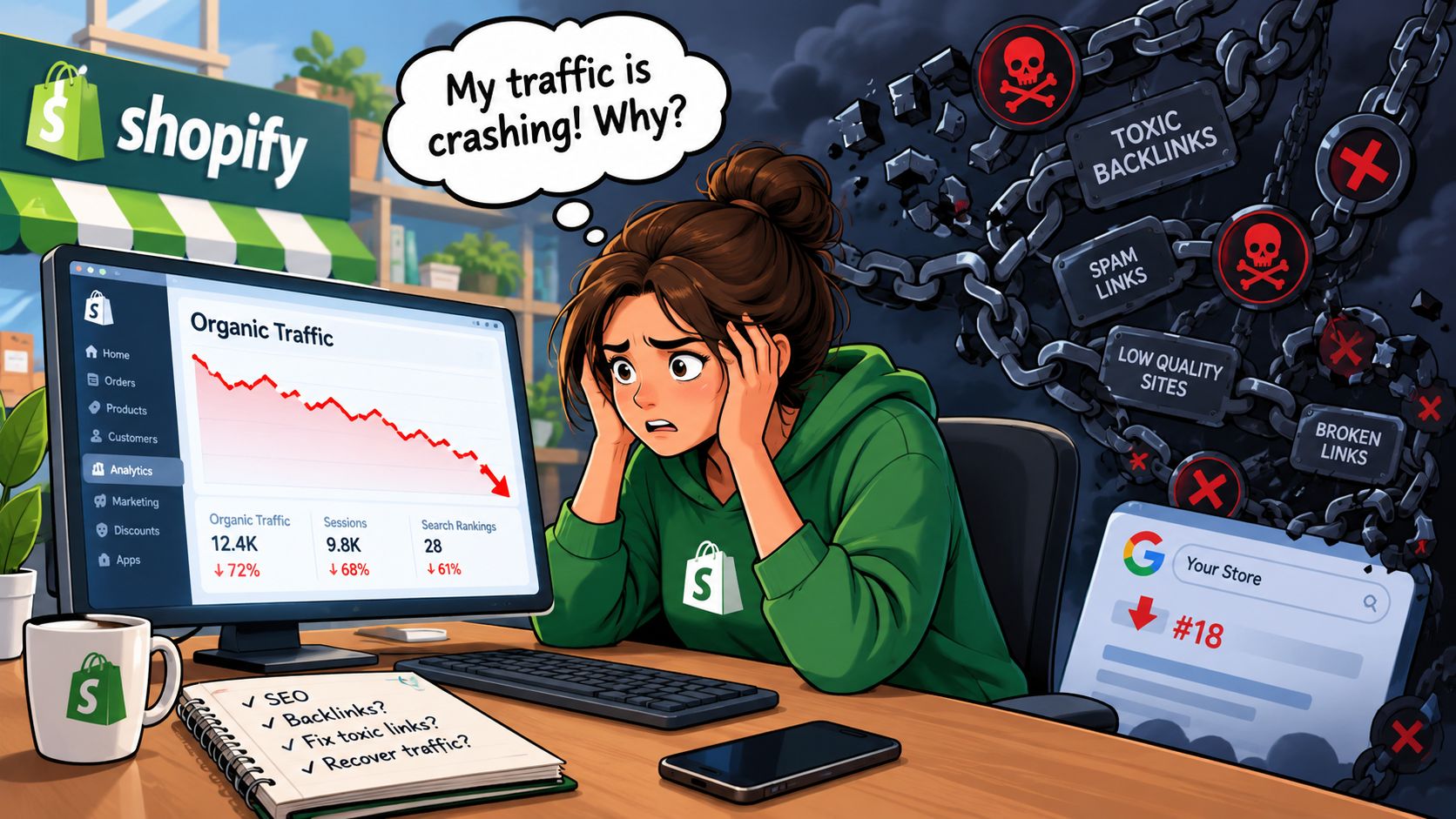
Your Shopify store has a strong product range, a fast checkout and pages that used to attract steady search traffic. Then growth stalls, category rankings slide and a quick look at an SEO tool shows thousands of backlinks you don't recognise. The problem may not be your latest collection or your CRO work. It may be the quality, concentration and history of the sites linking to your store.
A practical SEO backlink audit examines which domains link to you, where those links point, how they were created and whether they support or threaten your commercial pages. For ecommerce brands, that means connecting backlink evidence to product and category performance, not treating every link as an isolated row in a spreadsheet.
Why a Backlink Audit is Non-Negotiable in 2026
Backlinks can support discovery, authority and referral traffic, but they can also expose a store to unnecessary search and reputation risk. An old agency campaign might have created links across irrelevant directories. A discontinued microsite might still redirect into your Shopify store. A third party might publish content on a reputable domain and use it to promote unrelated pages or manipulated links.
That history matters because Google's official quality and reporting guidance treats pages that contain or receive “unnatural, artificial, deceptive, or manipulative” inbound or outbound links as reportable quality issues. The UK backlink guidance and reporting context reflects an important change in practice: auditing is now both a growth exercise and a compliance and trust control.
The commercial pages deserve priority
A homepage with a broad brand anchor profile can look healthy while revenue-driving pages receive no meaningful external support. Product launches, high-margin collections and category pages often need separate review because links may point to discontinued products, outdated campaign URLs or generic landing pages instead of the pages that now generate sales.
A store-wide backlink total won't answer the questions that matter:
- Which category pages attract authoritative links?
- Which product URLs have lost links after a migration?
- Are external domains concentrated on one old campaign page?
- Do links support pages that still exist and satisfy search intent?
A widely cited 2026 backlink analysis found that 64.2% of pages had zero backlinks, while another 22.4% had only one or two referring domains. The same analysis reported that pages with backlinks generated 14.4 times more organic clicks than pages without them, and found a 0.74 correlation between referring-domain count and rankings in positions 1 to 30. The 2026 backlink analysis also states that it covered 1,000 domains and 41.2 million referring backlinks.
The practical lesson isn't to buy links until every product page has a large profile. It's to identify link gaps and domain breadth. A few relevant, independent domains pointing to a valuable category can be more useful than a large cluster of repeated links from one low-value source.
Practical rule: Treat your backlink profile like an ecommerce asset register. Protect the pages that make money, investigate the links that create risk and record every decision.
Ignoring the profile leaves your store vulnerable to old campaigns, poor migrations and manipulative patterns that have nothing to do with the quality of your products.
Gathering Your Complete Backlink Data
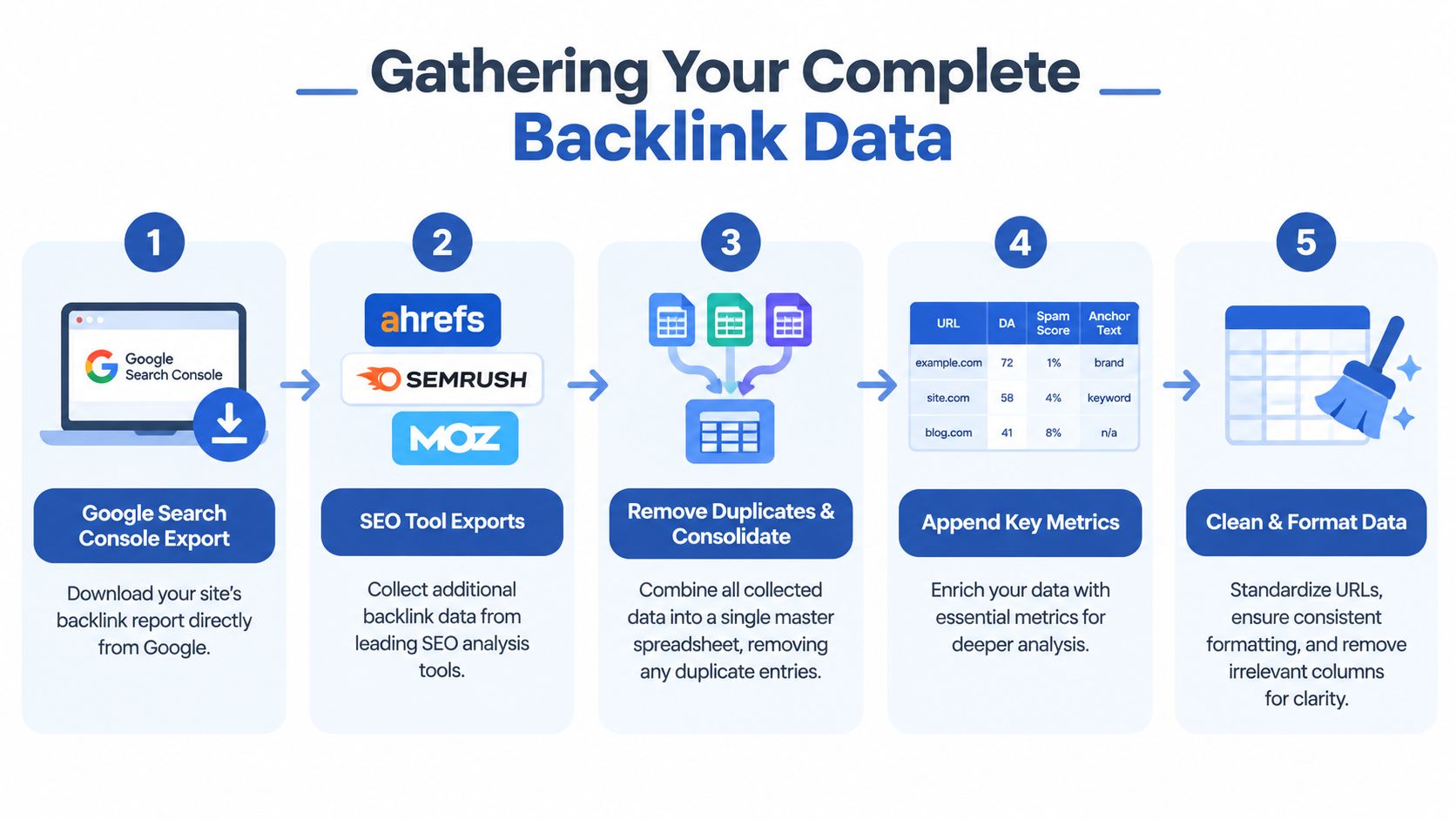
An audit is only as reliable as its dataset. Google Search Console provides a first-party view of links Google has surfaced, while Ahrefs, Semrush and similar crawlers provide broader external discovery. None should be treated as a complete standalone inventory.
The recommended starting point for a UK store is to export link data from Google Search Console and at least one third-party crawler, then merge and deduplicate the files. The UK backlink audit process identifies referring domains, rather than raw backlink count, as the most actionable first-pass KPI for finding concentration risk, broken links and non-indexed target pages.
Build one master sheet
Use a consistent structure before reviewing quality. Keep the original exports unchanged, then create a working sheet with fields such as:
- Source URL and source domain, so several links from one website can be grouped together.
- Target URL, including the exact product, collection, blog or homepage destination.
- Anchor text, copied as reported rather than rewritten.
- Link attribute, including follow, nofollow, sponsored or user-generated where available.
- First-seen and last-seen status, if your crawler provides it.
- Indexation and response status for the target page.
- Relevant tool metrics, such as domain authority estimates, traffic indicators and spam signals.
Export GSC links first, then pull referring domains and individual backlinks from Ahrefs or Semrush. If your store has changed platforms or URL structures, add historical exports, migration logs and known campaign domains. A link that appears harmless in a current crawl may make sense only after you understand how an old promotion was built.
Clean before interpreting
Standardise protocol and hostname variations, remove exact duplicates and group URLs by referring domain. Don't delete repeated links blindly. Several editorial links from separate pages may reveal a useful partnership, while thousands of sitewide footer links may indicate a very different pattern.
For Shopify stores, compare every target URL with the current sitemap and canonical URL. Mark redirects, soft 404s, discontinued products, out-of-stock collections and pages blocked from indexing. You can use a broader technical SEO audit checklist alongside the backlink sheet, because link value is limited when the destination no longer works properly.
The embedded walkthrough below can help teams align their export and cleaning process:
Don't compare tool totals as though they should match. Use the differences to find links Google sees, links third-party crawlers find and links that may have disappeared during a migration. That comparison gives you a defensible foundation for analysis.
Scoring Link Quality and Identifying Risk
A backlink doesn't become valuable because a tool assigns it a high score. Quality comes from the relationship between the linking domain, the page context, the target URL and the reason the link exists.
A niche review website linking naturally to a relevant product guide is a different asset from an irrelevant forum linking to a collection page with an exact-match commercial anchor. Both may appear in the same export, but they deserve different decisions.
Use signals, not a single toxicity score
Review each referring domain and its most important links through several lenses:
- Authority estimates: DA, DR and similar metrics can help prioritise review, but they're comparative tool signals, not Google classifications.
- Niche relevance: A specialist retailer, publisher or community related to your products gives stronger contextual evidence than an unrelated general directory.
- Anchor language: Branded, URL-based and descriptive anchors usually look more natural than repeated commercial phrases aimed at the same page.
- Placement and context: An editorial mention within a useful article deserves more attention than a footer, sidebar, comment or template block.
- Referring-domain breadth: Independent domains matter more than a large number of links repeated across one site.
- Visitor value: A link that sends relevant visitors may be useful even when it carries a limited ranking signal.
The 2026 analysis cited earlier found a 0.74 correlation between referring-domain count and rankings and reported 14.4 times more organic clicks for pages with backlinks than pages without them. Those findings support a quality-first approach, not a race for raw link volume. The link attribute checking guide can help you verify whether an important link is follow or nofollow, but don't discard nofollow links automatically. They can still send customers, support brand discovery and provide a natural profile.
Score destinations by business value
A link to a high-margin collection may deserve faster review than a link to an old blog post, even when both sources look similar. Add a commercial-priority field to your spreadsheet and classify target URLs as:
| Destination | Audit question | Typical action |
|---|---|---|
| Product page | Is the product live, indexable and commercially important? | Preserve relevant links and repair broken destinations |
| Category page | Does the link support a strategic search topic? | Assess relevance, anchors and referring-domain diversity |
| Campaign page | Is the campaign still active or should it redirect elsewhere? | Map old links carefully before changing redirects |
| Blog or guide | Does it earn links that assist product discovery? | Retain useful assets and connect them to relevant collections |
| Homepage | Is the profile mainly branded and natural? | Monitor concentration without chasing more homepage links |
Classify links as healthy, neutral or risky, but record why. “Low authority” isn't enough evidence for removal. A small specialist site can be highly relevant, while a large domain can still host a manipulative or irrelevant placement.
The strongest audit spreadsheet records a decision and the evidence behind it, not just a score copied from a tool.
Pinpointing Genuinely Toxic Backlinks
Toxicity is a pattern diagnosis. One unfamiliar domain isn't automatically harmful, and one nofollow link isn't automatically useless. The concern rises when several signals point to deliberate manipulation, hacked content, irrelevance or an unnatural network.
For ecommerce stores, start with links that combine a questionable source and a commercially valuable destination. A spam cluster aimed at a product page deserves quicker investigation than an isolated mention on an abandoned personal blog.
Look for repeated manipulation
Common warning signs include:
- Exact-match anchor repetition: Many domains use the same commercial keyword for one product or category, especially when the wording doesn't fit the surrounding content.
- Link-farm patterns: The site publishes thin pages across unrelated industries, carries large numbers of outbound links and offers little independent editorial value.
- Private network signals: Multiple domains share similar templates, ownership clues, hosting patterns or publishing behaviour, then link to the same commercial pages.
- Language and country mismatch: A UK store receives promotional links from unrelated foreign-language sites with no audience or business connection.
- Sitewide placement: The same link appears in footers, sidebars or templated blocks across many pages without a clear user benefit.
- Hacked or injected content: A previously legitimate domain contains hidden links, strange pages or sudden content about unrelated products.
- Paid or sponsored links without appropriate treatment: The placement appears bought for ranking influence rather than disclosed promotion or genuine referral value.
A UK audit checklist reports that the average website contains 12% to 18% toxic or low-quality backlinks, making roughly one in every five links a practical triage benchmark, not an automatic removal quota. The UK audit research supports using that range to prioritise investigation while still judging each link on evidence.
Check newer abuse patterns
Older audits often stop after finding directories and comment spam. That misses risks associated with expired domain abuse, site reputation abuse, hacked content and parasite-style publishing. An expired domain from a previous marketing campaign may retain links, but its current content, redirects or ownership can be unrelated to your brand. Review the domain history, the current page and the path into your store before deciding whether a redirect is helping or creating a policy risk.
Don't confuse an unhelpful link with a harmful one. Google may ignore a low-quality link without requiring action. Flag a domain for remediation when the evidence suggests manipulation, a coordinated attack, hacked placement or a pattern that connects directly to commercial URLs.
Keep screenshots, source URLs and notes for every serious candidate. That record protects your team from impulsive disavow decisions and makes future reviews faster.
Creating Your Remediation Plan Disavow or Outreach
Remediation starts with classification, not deletion. The wrong response can remove a link that sends customers or supports a valuable product page, while failing to address a coordinated spam cluster leaves the underlying risk in place.
Choose outreach when the problem is specific
Manual removal works best when you can identify the publisher, the exact link and a credible reason for the request. Ask for removal when a link is clearly paid, hacked, irrelevant to the site's audience or tied to an old campaign that no longer represents the brand.
Keep the request factual. Include the source page, target URL and preferred action. Don't threaten the publisher, offer money for removal or send a mass template that looks like spam. Record the date, response and outcome in the audit sheet.
Outreach has a clear trade-off. It can remove the link permanently and sometimes opens a useful editorial relationship, but owners may not respond, the site may be unreachable or the link may exist across a large network.
Reserve disavow for evidence-backed cases
Google's Disavow Tool tells Google to ignore selected links. It doesn't remove them from the web, repair a bad redirect or clean an expired domain. Use it cautiously, especially if your concern is based only on a tool's toxicity label.
| Situation | Preferred response | Reason |
|---|---|---|
| One identifiable harmful link | Outreach first | The publisher may remove it cleanly |
| Several links on a responsive, relevant site | Outreach with a documented list | A relationship may resolve the issue without broader action |
| Large spam cluster across unreachable domains | Consider domain-level disavow | Manual removal isn't realistic |
| Low-authority but natural-looking mention | Usually leave it | Weak isn't the same as manipulative |
| Link from an active product review | Protect it | Referral and relevance may outweigh tool scores |
| Old campaign redirect with unclear history | Investigate first | The redirect may affect both users and search interpretation |
Protect the internal journey
Removing an external link doesn't solve a destination problem. If a valuable category page has lost links, repair the URL, preserve relevant redirects and strengthen the route from that category to products, guides and related collections. A documented internal linking strategy helps distribute users and crawlers through the store after external links arrive.
Before submitting a disavow file, validate each candidate in the fresh master dataset and check the domain manually. Keep an archived copy of the original file, a reason for every entry and a review date. Don't disavow an entire domain solely because one page looks poor unless the wider domain pattern supports that decision.
Decision standard: If you can't explain why a link is manipulative, don't disavow it yet.
Turning Your Audit into an Ongoing Strategy
A completed audit should change how your store earns links. The useful output isn't a cleaned spreadsheet. It's a clearer picture of which publishers, content formats and commercial destinations deserve future investment.
Start with the links that combine three qualities: strong topical fit, genuine editorial context and a target page that matters to the business. If independent product reviewers consistently link to comparison content, build more comparison content. If category pages earn attention after digital PR, make those pages easier to cite with clear specifications, original guidance and stable URLs.
Turn findings into an acquisition brief
Your next link-building plan should answer practical questions:
- Which domains are missing? Compare relevant publishers linking to competitors but not to your store.
- Which pages attract attention? Identify guides, tools, comparisons or collections that already earn external references.
- Where are the gaps? Find important product and category pages with little referring-domain coverage.
- What should you stop doing? Remove tactics that create repetitive anchors, irrelevant placements or campaign links with no lasting value.
- What can be measured? Track referring domains, destination status, referral sessions, organic visibility and commercial actions together.
Content teams can use tools to research topics, organise briefs and accelerate production, but editorial review still matters. If you're assessing options, resources that help teams discover AI content tools can support workflow planning. They shouldn't be used to generate scaled pages or link bait without checking accuracy, originality and search intent.
Review on a repeatable rhythm
Most UK businesses should schedule a quarterly backlink review, as recommended in UK-focused audit guidance, with additional checks after a migration, agency change, major campaign or unusual ranking movement. The review doesn't need to reclassify every known link. Compare new referring domains, lost links, anchor changes, redirect destinations and suspicious clusters against the previous baseline.
Google's current spam policies list link spam, expired domain abuse and site reputation abuse, so a recurring audit must examine more than classic toxic directories. The recent backlink policy review also highlights that enforcement is continuous and update-driven, which makes a one-off disavow exercise an incomplete control.
For a repeatable store-side workflow, keep the original exports, decisions and screenshots together. A practical SEO audit example can help teams connect backlink findings with technical, content and commercial priorities rather than filing link data separately.
Treat every review as a feedback loop. Healthy links show what the market values, risky links reveal where governance failed and missing links identify opportunities for product-led content or digital PR.
Grumspot helps Shopify and Shopify Plus brands connect backlink findings with technical SEO, storefront performance and revenue-driving page improvements. Visit Grumspot to discuss a focused ecommerce SEO audit, migration review or ongoing optimisation plan for your store.
Let's build something together
If you like what you saw, let's jump on a quick call and discuss your project

Related posts
Check out some similar posts.
- shopify seo
Choosing the right SEO app for Shopify means weighing features against speed, scripts, and plan limi...
Read more
- xml sitemap best practices
Master XML sitemap best practices for 2026. Our guide covers structure, submission, troubleshooting,...
Read more
- voice search optimization
Boost Shopify store visibility with our voice search optimization guide. Get actionable steps for ke...
Read more
- shopify seo audit
Unlock your store's potential with our Shopify SEO audit guide. Fix technical, on-page, and performa...
Read more